
What the Numbers Caught: A Night of Force Tells All about the DMPD
ANALYSIS: Iowa nonprofit Just Voices releases study of Des Moines Police’ Use-of-Force Reports from the George Floyd protests.
Black Iowa News has published exclusive articles produced by the nonprofit Just Voices about the 2020 George Floyd Protests and their original work titled The People’s History. This piece is the work of the author and does not necessarily reflect the views of Black Iowa News. Here is Just Voices’ latest piece.
After the Iowa Supreme Court compelled the city of Des Moines to produce Use-of-Force Reports from the Des Moines Police Department for the 2020 calendar year, Just Voices conducted an analysis of the 387 reports received. Only 18 of those reports related to the 2020 protests following George Floyd’s murder, which occurred on May 25, 2020, in Minneapolis, Minnesota. Our analysis of the available data from the early days of the protests found 208 arrests by the Des Moines police. The following pie chart, produced by Just Voices, reflects the disparity between the arrests and filed Use-of-Force Reports from those early days.
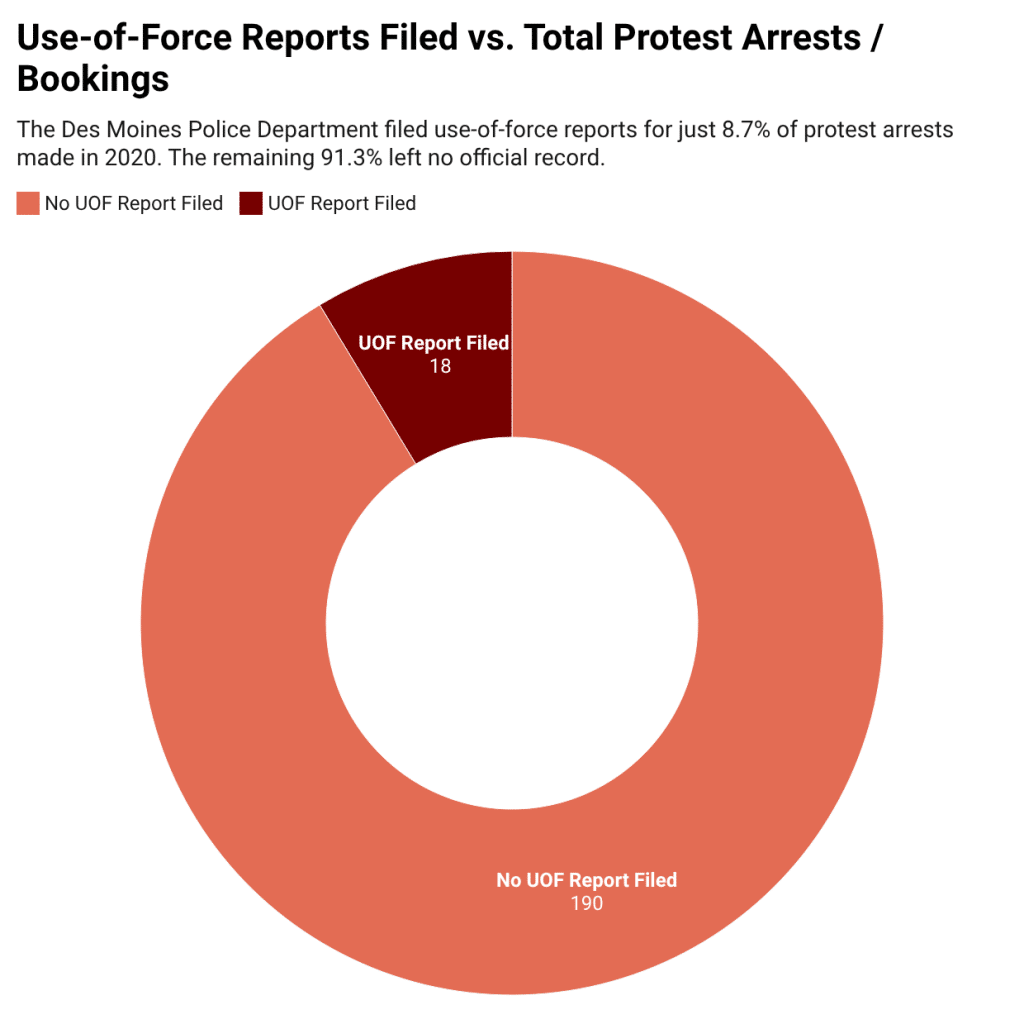
The data supports anecdotal reports and officer testimony obtained by Just Voices that Des Moines police officers were not required to file Use-of-Force reports, despite the requirement in their standing General Orders. The filing of such reports is also generally considered a “best practice.”
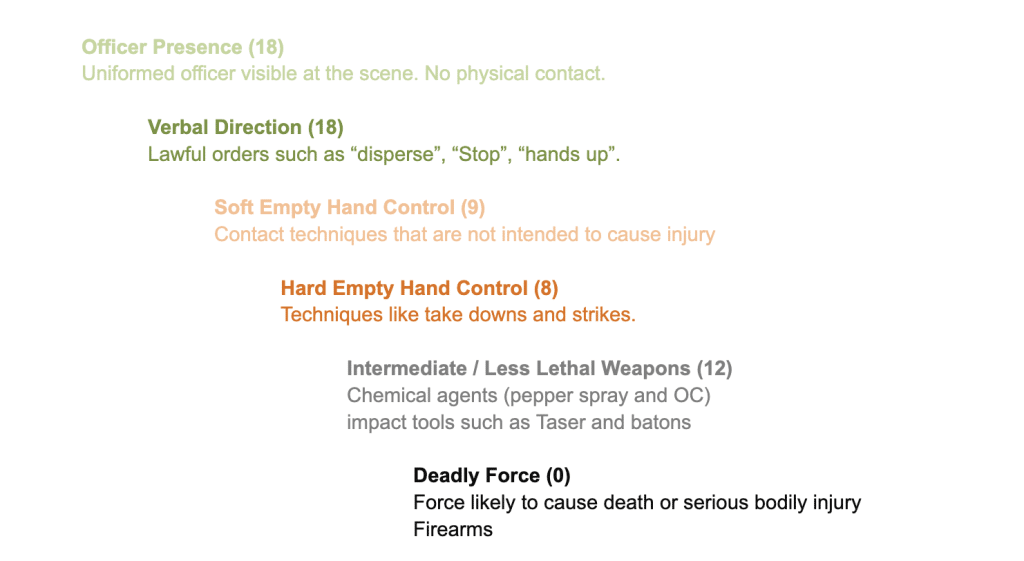
In the U.S., police use of force is commonly rated along a spectrum. (The numbers shown at each level tell how many appeared at that level in the 18 reports that were filed in Just Voices’ analysis.
In this Volume of the People’s History, Just Voices shows a series of incidents that occurred in approximately 10 minutes, beginning at 2:40 A.M., on May 31, 2020, at the corner of Court and 3rd in downtown Des Moines. The videos highlight the failure of the Des Moines Police Department to follow its own rules and national standards in the filing of Use of Force Reports. No Reports were filed, and no arrests were made in any of the incidents that were caught on camera, Just Voices found.
The 3rd & Court footage, suggests that if two video recordings, over about 10 minutes, on a downtown surveillance camera, captured multiple, unreported use-of-force incidents, how many other unreported incidents are there?
Just Voices found no evidence that any civilians in the video footage from that 10 minutes posed a threat, carried a weapon, caused property damage or violated any law.
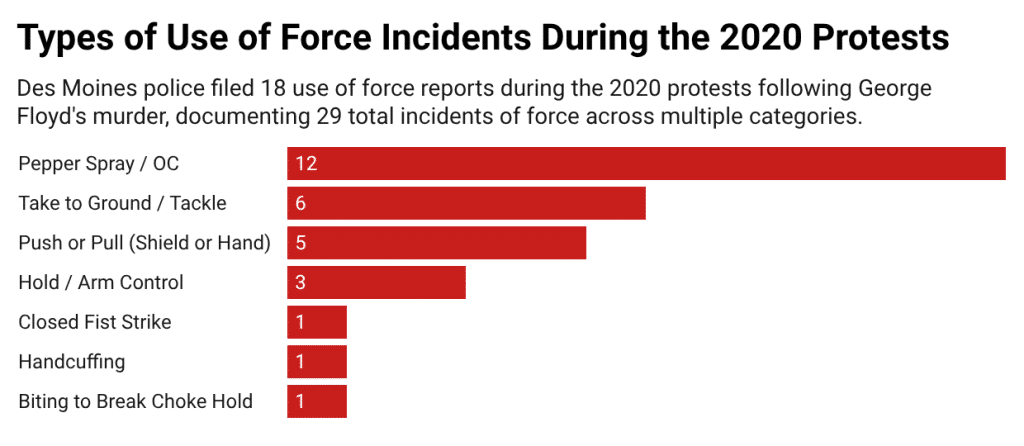
In addition to what is shown in the 18 reports that were filed, and the failure to file any reports on the video records from 3rd & Court, additional unreported incidents of force being used were uncovered and reported in volumes 1 and 2 of the People’s History.
When we add our review of news reports, video records and body camera records from those days, it is not possible to provide a final, correct number of times and ways in which Des Moines police officers used force and failed to file any report.
A final example of the extent to which force was being applied. In the first few days of the protests, the Des Moines Police Department used so much of their chemical weapons that they had to seek supplies from other municipalities. As with much else about the DMPD conduct during the protests, we will never have a final report.
The Iowa Supreme Court ruling also cited a statistic from the department’s 2020 summary report: Of the 387 use-of-force reports filed that year, only four resulted in internal disciplinary action.
The data that does exist points in one direction. The data that doesn’t exist points in the same direction: A lack of accountability and transparency by the Des Moines Police Department and unreported incidents of officer violence, leading to unidentified victims.
Author
Related Articles
Seated, Not Silent: Why I Choose Not to Stand for the Pledge
OPINION: Do you stand for the Pledge of Allegiance? Not everyone does. Read Lya Williams’ rationale for her decision.

The Iowa America Thought It Knew: Race, Democracy and a Record Worth Remembering
Iowa has a rich history of Black Iowans making an impact on politics locally and nationally, says a former Iowa legislator
OPINION: The Problem With Black Women
The headline may make you uncomfortable. It should. Sometimes the best way to expose a myth is to state it plainly, then dismantle it piece by piece.