
Sergeant says in deposition he was told use-of-force reports weren’t required during 2020 George Floyd Protests in Des Moines
ANALYSIS: Jacob Hedlund, now a Des Moines police sergeant, filed more use-of-force reports than any other officer during the 2020 protests, according to testimony obtained by Just Voices, a Des Moines nonprofit.
Black Iowa News has published exclusive articles and analysis from Just Voices about the 2020 George Floyd Protests and aftermath dubbed the People’s History. The piece is the sole work of Just Voices and does not necessarily reflect the views of Black Iowa News. Here is Just Voices’ latest piece.
For three years, Just Voices fought to obtain the use of force reports that Des Moines police officers filed during the 2020 protests over the murder of George Floyd. The city refused to release them. On Oct. 12, 2022, Harvey Harrison, on behalf of Just Voices, filed a lawsuit asking the court to order the City of Des Moines to produce the reports. The Polk County District Court ordered the city to produce them. The city appealed, and on March 14, 2025, the Iowa Supreme Court affirmed that order. The decision is discussed in Volume Two of the People’s History, page 55.
The Deposition
Jacob Hedlund graduated from Buena Vista University with a degree in criminal justice and a minor in coaching. In 2020, he was a Senior Officer with the Des Moines Police Department and, since 2012, a member of Metro S.T.A.R., a tactical team he described as a training unit designed to bring younger officers “up to speed with our tactics.” He left the unit in March 2021, when he was promoted to Sergeant. In a May 31, 2022, deposition for the civil lawsuits that followed the protests, Hedlund agreed he was good at his job, describing himself there as a hard worker, dedicated, calm, rational and someone who thought things through. (Page 11, lines 11–15.)
When protests over the murder of George Floyd filled the streets of Des Moines in late May 2020, Hedlund and his Metro S.T.A.R. unit were called to respond. He filed three Use of Force reports during the protests, more than any other officer in the department. His testimony describes other uses of force he witnessed, at a time when, by his account, officers had been told they didn’t need to file reports. He was later named as a defendant in three civil lawsuits brought by people who said police had harmed them. He was one of only four officers who both filed use of force reports during the first days of the protests and were later sued. The others were Adam Herman, Brandon Holtan and Jeffrey George.
When Hedlund was asked whether he had received any instruction about use of force reporting, he said:
“I believe we were told we didn’t have to do use of force reports,” he said. (Page 29, lines 9-10)
When asked who told him that, he replied: “I believe it was Metro S.T.A.R. command.” He identified the commanders as Schafnitz and Wellman and said the instruction had been communicated through team leaders and then passed down through the teams.
His reports and testimony trace his movements through the protests. On Friday, May 29, the first night, he stood on the skirmish line at the police station in the East Village. He made no arrests and filed no reports.
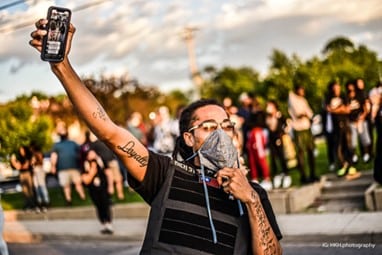
The next afternoon, Saturday, May 30, he was called in on his day off from his regular traffic unit assignment. After a briefing, his unit went to the Polk County Courthouse, where, according to police reports, officers were being pelted with bricks and bottles before tear gas was deployed to disperse the crowd.
At about 9:51 p.m., his team was sent downtown “due to reports of the Court House being set on fire.” Near the 600 block of Cherry Street, Hedlund encountered a male protester. This is what he reported in his use-of-force report filed June 10:
“Officers were being assaulted with water bottles and rocks. A command decision was made to deploy gas and pepper spray on the hostile crowd. After deploying the chemical munitions, I observed a male wearing a gas mask and carrying a homemade shield standing in the street in an aggressive manner while most of the crowd had dispersed from the area. The male raised his arms up towards the officers and seemed to be trying to agitate the situation . . . I ran towards the male and tackled him to the ground . . . I believe that probable cause exists for the charges of rioting, due to the fact that Wolf was involved in a group of three or more individuals who were throwing items at law enforcement officers, as well as causing property damage to the Polk County Courthouse.
Probable cause also exists for the charge of failure to disperse as lawful commands were given to the large and hostile crowd to leave the area. Tear gas was deployed in order to disperse the crowd at which point Wolf continued to stand in the tear gas while wearing a gas mask.”
In the chaos of the scene, Hedlund misidentified Wolf in his arrest report and filed a correction weeks later, after a detective flagged the error. Iowa Courts Online shows Wolf pleaded guilty to Failure to Disperse, a simple misdemeanor. No record appears on the rioting charge. Wolf was not part of any later civil lawsuit.
On Monday, June 1, Hedlund was on a skirmish line pushing a crowd from the State Capitol down East Locust Street. He saw a man who, in his words, “was outfitted with a mask and clear safety glasses that many protesters were wearing to combat OC spray.” When the man refused to disperse, Hedlund pepper-sprayed and arrested him. The man was Paxton Williams, an employee of the Iowa Attorney General’s office. The Polk County District Court dismissed his failure to disperse charge. Williams then sued Hedlund and several others in federal court. All defendants except Hedlund were dismissed before trial. The case was tried to a jury, and on Oct. 28, 2024, the court entered the following order:
IT IS ORDERED AND ADJUDGED: In accordance with the unanimous verdict by the jury, judgment is entered against plaintiff Paxton Williams and in favor of defendant Jacob Hedlund.
Hedlund was also present when word came of a break-in at a Hy-Vee near the courthouse. He walked with a small group, including Lieutenant Schafnitz, to the Court Avenue district as officers pushed the crowd south. Later, on a roaming patrol with orders to clear downtown and make arrests, his unit stopped a group on the 400 block of Locust Street. Hedlund arrested one of them, Jayvione Lewis, for failure to disperse, though he acknowledged in his deposition that he had no firsthand knowledge Lewis had heard a dispersal order. The charge was dismissed. Lewis later joined a lawsuit filed by 14 people that ended in an $800,000 settlement against the city of Des Moines.
On June 22, Hedlund was part of a three-person arrest team at the Capitol during a protest documented in Volume One of the People’s History. He later described the incident in his use of force report:
“I observed an individual in a red shirt that at one point appeared to be moving backwards, pushing up against the officers with shields. I then reached out and grabbed this individual by the shirt and pulled them backwards to the ground. When doing so I was able to keep a hold of the shirt in order to prevent the individual from striking their head on the ground. When grabbing the individual’s shirt I heard and felt the shirt began to tear. The individual was placed on their stomach, while myself, Officer Engle and Sergeant Dixon placed them into custody without any further use of force. The individual was identified as Emily Ewing.”
Ewing’s failure to disperse charge was dismissed. She did not file a civil lawsuit.
Hedlund’s weeks on the protest lines were a small part of a career that stretches back more than a decade, so Just Voices looked more broadly at his record, drawing on public records and his deposition. The Des Moines Police Department refused to respond to requests for information about him.
Like many of his colleagues, Hedlund does not live in Des Moines. He and his wife have owned a home in a Des Moines suburb since Oct. 1, 2021. His 2025 salary was $158,894, which GovSalaries reports is 107% higher than the average and 97% higher than the median salary in Des Moines. He testified that he spent a year on the department’s Special Enforcement Team (SET), whose operation Just Voices documented in a separate report. Just Voices asked the city to provide “Copies (or listing) of any awards, honors or special recognition during employment of the officer with the department,” which it did not receive.
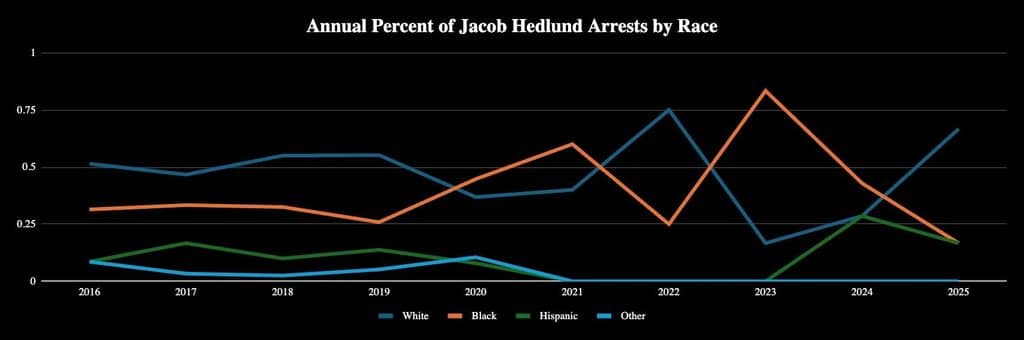
For its Racial Profiling project, Just Voices has collected data from the police department, the Iowa Department of Transportation and the Polk County Sheriff’s office to determine whether DMPD citations and arrests are proportionate to the city’s racial demographics. Hedlund’s bookings at the Polk County jail from 2016 through 2025 are shown below, first as numbers by race and then as percentages.
| Bookings | 2016 | 2017 | 2018 | 2019 | 2020 | 2021 | 2022 | 2023 | 2024 | 2025 |
| White | 18 | 14 | 22 | 32 | 14 | 4 | 15 | 1 | 2 | 4 |
| Black | 11 | 10 | 13 | 15 | 17 | 6 | 5 | 5 | 3 | 1 |
| Hispanic | 3 | 5 | 4 | 8 | 3 | 0 | 0 | 0 | 2 | 1 |
| Other | 3 | 1 | 1 | 3 | 4 | 0 | 0 | 0 | 0 | 0 |
| Total | 35 | 30 | 40 | 58 | 38 | 10 | 20 | 6 | 7 | 6 |
Data compiled by Brian O’Donnell, retrieved from the Racial Justice Project.
Hedlund’s bookings peaked in 2019 at 58, while bookings of Black residents stayed between 10 and 17 per year. Black residents make up about 11% of Des Moines, yet from 2016 through 2019 they were 26% to 33% of his bookings, two to three times their share of the population. In 2020, the year of the protests, that jumped to 45%, while white residents, about 62% of the city, accounted for only 37%. On the percentage chart, the Black line crosses above the white line for the first time that year.
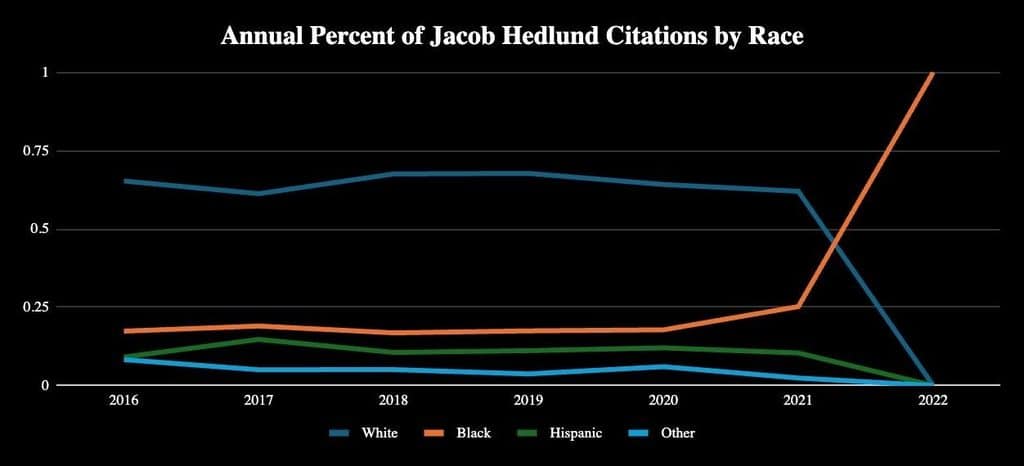
His citations from 2016 through 2022 tell a different story. They spiked starting in 2018 and peaked at 1,580 in 2020. Most went to white people, who received 61% to 68% each year, roughly in line with their share of the population. Black people received 17% to 19% from 2016 through 2020, and 25% in 2021. That is above their share of the city but far below their share of his arrests. That gap is the key finding: Hedlund’s traffic stops show a modest disparity, but his arrest decisions show a much larger one.
| Citations | 2016 | 2017 | 2018 | 2019 | 2020 | 2021 | 2022 |
| White | 158 | 158 | 691 | 621 | 1014 | 155 | 0 |
| Black | 42 | 49 | 172 | 160 | 281 | 63 | 1 |
| Hispanic | 22 | 38 | 108 | 102 | 190 | 26 | 0 |
| Other | 20 | 13 | 52 | 34 | 95 | 6 | 0 |
| Total | 242 | 258 | 1023 | 917 | 1580 | 250 | 1 |
Data compiled by Brian O’Donnell, retrieved from the Racial Justice Project.
Taken together, Hedlund’s conduct during the protests and his record in the years around them raise questions the Des Moines Police Department has declined to answer. The data do not explain why the racial disparity exists, but they support the activist community’s demands for civilian oversight of the Des Moines Police Department, greater transparency in its operations and an after-action review of its response following the murder of George Floyd.
Author
Related Articles
The Sharpest Pen: Truth, Courage & Ida B. Wells-Barnett
Opinion: Ida B. Wells-Barnett’s pursuit of the truth changed the craft of journalism, said writer Shade Burgs.
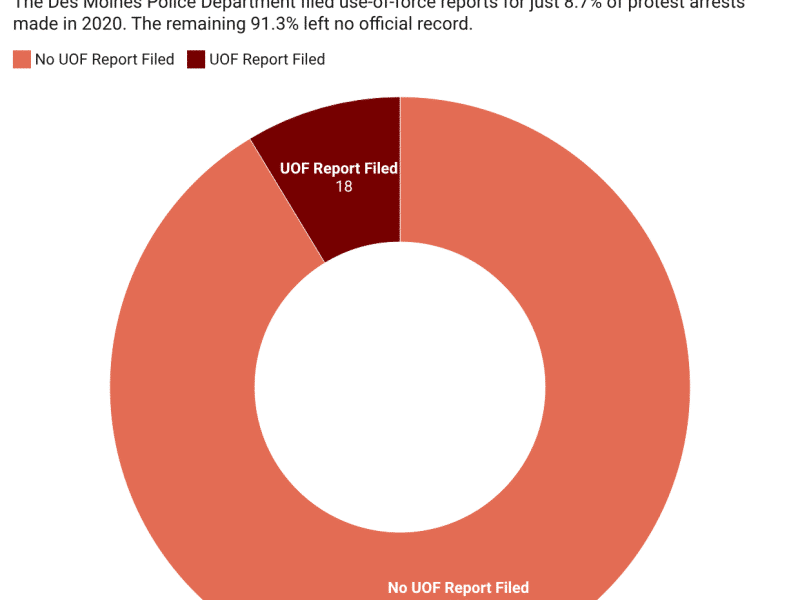
What the Numbers Caught: A Night of Force Tells All about the DMPD
ANALYSIS: Iowa nonprofit Just Voices releases study of Des Moines Police’ Use-of-Force Reports from the George Floyd protests.
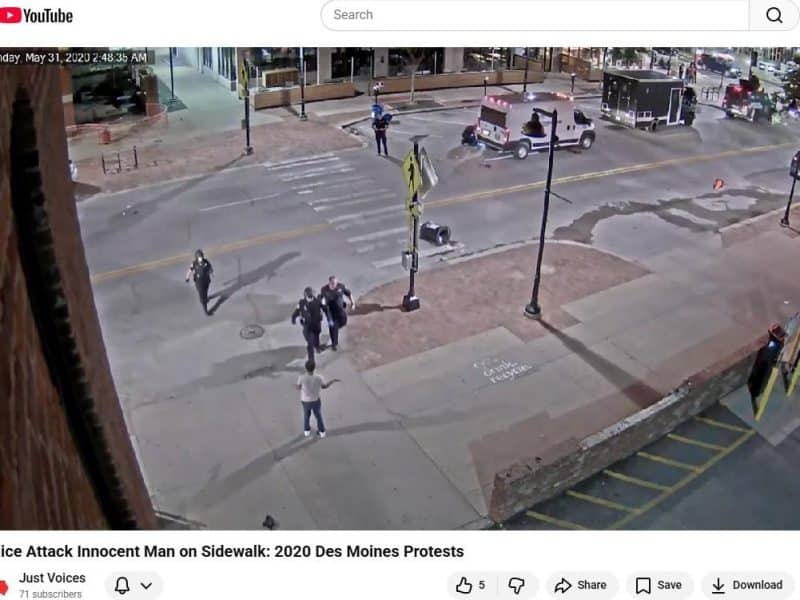
Profile of Des Moines police violence in aftermath of 2020 George Floyd protests
Officers caught on camera: Just Voices dives into video of Des Moines police officers assaulting a pedestrian on May 31, 2020 – a week after George Floyd’s murder.