
Profile of Des Moines police violence in aftermath of 2020 George Floyd protests
Officers caught on camera: Just Voices dives into video of Des Moines police officers assaulting a pedestrian on May 31, 2020 – a week after George Floyd’s murder.
Black Iowa News has published exclusive articles from Just Voices about the 2020 George Floyd Protests and the People’s History. The piece is the work of the author and does not necessarily reflect the views of Black Iowa News. Here is Just Voices’ latest piece.
By Lori A. Young
Days after George Floyd’s brutal killing on May 25, 2020, in Minneapolis, Minnesota, cities across America rose up in protest, including Des Moines. And like the capital city of Iowa, other areas’ police departments were caught “flat-footed” and unprepared to handle the huge crowds that were filled with deep emotions and demanding change.
Experts have noted that, of the over 7,500 protests during the summer of 2020, over 90% involved no violence, property damage or physical injury. This was also true in Des Moines. In spite of this, the Des Moines police department employed inappropriate tactics and weapons and a number of DMPD officers used excessive force and made wrongful arrests of peaceful protesters. Every day people who were exercising their Constitutional rights to protest.
Just Voices is now preparing Volume 3 of “The People’s History: A Study of the Summer of 2020 Protests in Des Moines, Iowa”. In Volume 1, the focus was on sharing the stories of protestors and revealing data. Volume 2 focused on key lawsuits stemming from protestors who were violated by the police and sought justice in the civil court system. And now, Volume 3 focuses on the many instances of unnecessary police force by the DMPD, most of which went unreported and left those responsible without repercussions.
Protect and Serve
Ask folks what the core duty of police is and many will tell you it is “to protect and serve the community.” New Des Moines Police officers swear to the following oath as they begin working for the DMPD:
“I, (NAME), do solemnly swear that I will support the Constitution of the United States and the Constitution of the State of Iowa, and that I will faithfully and impartially, to the best of my ability, discharge all the duties of the office of Police Officer for the City of Des Moines, Iowa, as now or hereafter required by law.”
But in the early morning hours of May 31, 2020, there was one young man that needed protection from three senior police officers who used unnecessary and excessive force while not realizing that they were being recorded. These three officers chose to approach, harass and assault a young man, walking down the street in the early hours of the morning on May 31.
We’ve Got the Video
If a picture is worth a thousand words, then a video tells all. The young man is shown walking and talking on his cell phone. Yes, it’s about 2:45 a.m., when most folks are asleep, but it appears he has a destination in mind. Perhaps he’s headed home to a downtown apartment, or maybe he’s walking to his car after a night of protests that flooded the Court Avenue area of downtown Des Moines. But he’s alone, walking slowly and breaking no laws as we observe him.
The young man appears to be the only pedestrian around this quiet early morning. Finally, a hectic late night gives way to early morning peace as the street lights cast soft warm light on the street below.
An occasional car drives by, while two police vehicles are parked on the opposite side of the street. Inside one of the vehicles are at least three officers. These officers jump out and cross the street. Walking at a determined pace, with their eyes targeted on this young man, they advance towards him. Even though there’s no sound in the video, these officers must have said something to the young man who stops walking and puts his arms out, not quite in a “hands up” posture but definitely compliant.
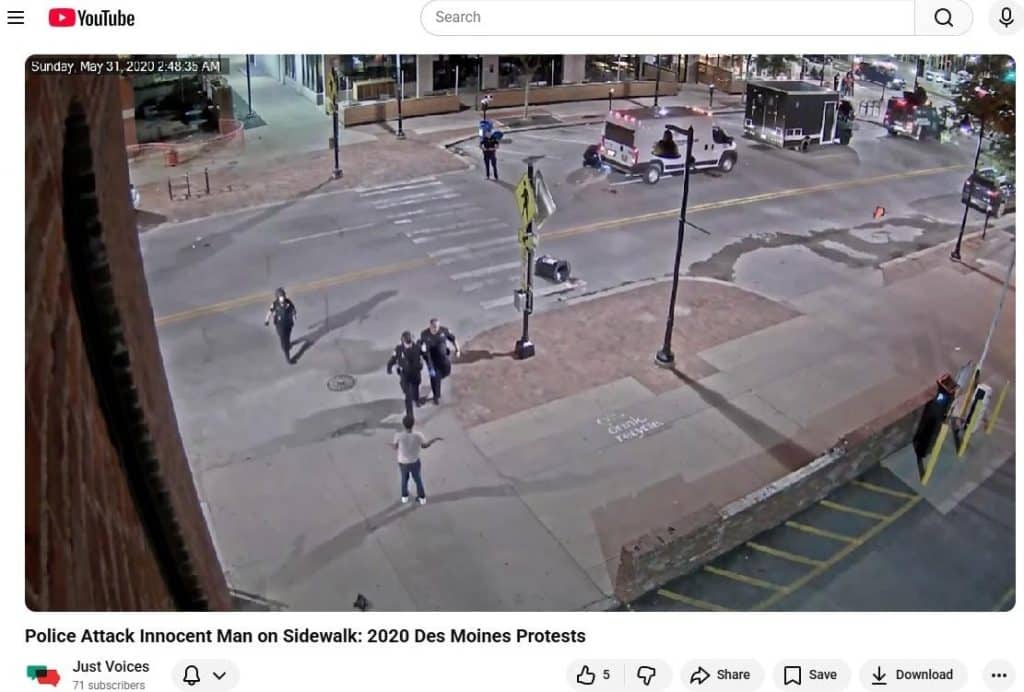
Once the three officers are close, and without hesitation, Christopher Hardy, a captain on the force, knocks him down to the ground. It appears that the young man’s cell phone, which he was just using, hits the pavement.
Next, Lieutenant Kirk Bagby, stands over him yelling, while Hardy picks up the object and puts it in his pocket. Senior Officer Jennifer Grose watches as the incident unfolds and does not interact. The young man gets up, looking disoriented, pulls up his pants and continues on his way.
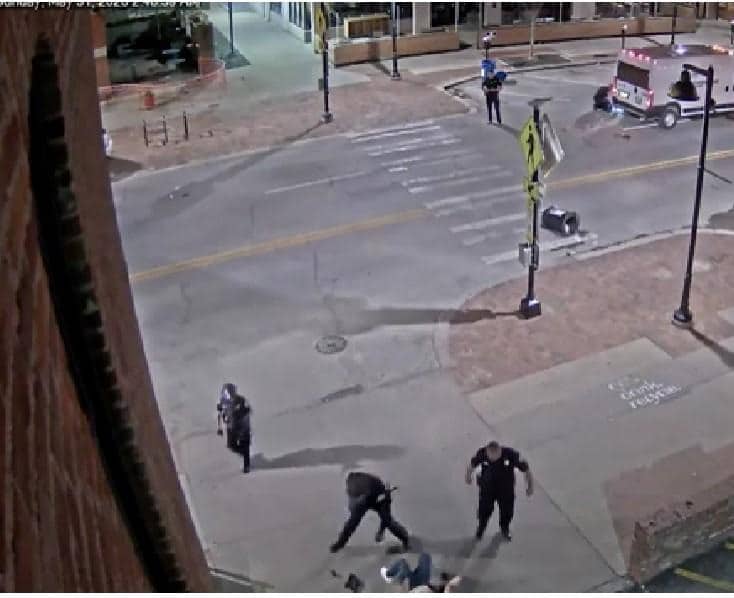
What happened to this young man was wrong. It was wrong to push him down! It was wrong to yell at him and just walk away. No arrest was made. No incident report was filed! No Use of Force Reports were filed. All we have is this building security camera footage from the parking ramp at Third and Court Avenue.
The video is only about 30 seconds long. Yet, when reviewed alongside the stories from Volumes 1 and 2 of The People’s History and the parking ramp video from the previous essays in this series, it is instructive! Des Moines Police Department officers did not hesitate for an instant to improperly use physical force and pepper spray against people who represented no threat and were not resisting in any manner.
Watch the video here: https://youtu.be/g3Upy0ulA0Q?si=RiYeZP9T5vHr6e18
Lawful but Awful
According to the Leadership Conference on Civil Rights’ New Era of Public Safety report, Federal law provides minimal and vague guidance for the use-of-force in policing situations. The report states:
Relying on the bare constitutional requirement for uses of force — much like relying on the minimum constitutional protections for stops and searches (as discussed in Chapter 3) — fosters “lawful but awful” practices that disserve police and the public. Many departments recognize this shortcoming and, even though not compelled to do so by courts, have adopted force policies and practices that go beyond Graham’s minimum constitutional requirements. (page 117)
The report offers several recommendations on how a police department should build their use-of-force policies and practices. One suggestion, which is foundational, is “Permit the use of force only when necessary to resolve conflict and protect public and officer safety.” (Page 114)
The young man that we observe in this video was not engaged in conflict, nor was he a threat to the police or the public that early Sunday morning. Therefore, no interaction was needed, at least not the kind the police delivered.
DMPD Policy on Reporting Use-of-Force
According to DMPD procedures, any use of force must be documented and submitted at the end of the officer’s shift. Here’s what their policy stated as of December 2020:
- Policy
- “In the performance of their duties, employees shall value and preserve human life and use only reasonable force as defined herein. When objectively reasonable, officers shall attempt to utilize deescalation techniques to resolve the situation peacefully.
- Officers shall only use force that is objectively reasonable to make an arrest or effectively bring a person or incident under control, while protecting the safety of the officer and others.
1. The decision to use force “requires careful attention to the facts and circumstances of each particular case, including the severity of the crime at issue, whether the suspect poses an immediate threat to the safety of the officer or others, and whether they are actively resisting arrest or attempting to evade arrest by flight.”
The Recognized Use of Force Continuum
The continuum below lists the levels of force most U.S. agencies recognize, ordered from least to most severe. Officers are trained to use only the force that is objectively reasonable under the totality of the circumstances (Graham v. Connor, 1989), and to de-escalate whenever feasible
| Police Use of Force Continuum 1. Officer Presence — Visible, identifiable law enforcement. Deters through authority alone. No physical contact. 2. Verbal Commands — Calm requests escalating to firm, loud directives (“Stop,” “Show me your hands”). 3. Empty-Hand – Soft Techniques — Grabs, holds, joint locks, escorts, pressure-point compliance. Low injury risk. 4. Empty-Hand – Hard Techniques — Strikes, punches, kicks, takedowns. Higher injury risk; still classed as non-lethal. 5. Less-Lethal Intermediate Weapons — OC/pepper spray, batons, conducted electrical weapons (Tasers), bean-bag rounds, kinetic-impact projectiles, pepperball launchers. 6. K-9 Deployment — Trained police canine used to apprehend a fleeing or assaultive subject. High injury potential; often classified just below lethal force. 7. Lethal Force — Firearms or any technique likely to cause death or great bodily harm. Reserved for an imminent threat of death or serious bodily injury to the officer or others. Notes & Disclaimer Educational reference only. This document summarizes general principles drawn from publicly available policing standards (Graham v. Connor, 1989; IACP and POST training models). It is not legal advice and is not a substitute for any specific agency policy, statute, or accredited training program. Continuum is fluid, not linear. Officers may move up or down levels based on the totality of the circumstances and are not required to step through each level sequentially. Agency variation. Specific tools (e.g., neck restraints, certain projectiles) are authorized, restricted, or banned depending on jurisdiction. Always defer to the controlling agency policy. |
As far as Just Voices can determine, none of the three, long-time officers involved in this incident filed any timely report. Additionally, Just Voices does not know the identity of the young man pushed down for being on a public sidewalk in the early hours of this summer morning. If anyone reading this essay knows his identity, please have him contact Just Voices at info@justvoicesiowa.org.
Through our research, however, we have identified the three senior officers directly involved in this incident. They are:
- Lieutenant Kirk Bagby
- Senior Police Officer Jenifer Grose (now a sergeant)
- Police Captain Chris Hardy (now retired)
The second part of this essay will take a closer and personal look at these three long-time DMPD officers who, as senior law enforcement, should have known better. Watch for Part II soon.
Sources: Armed Conflict Location & Event Data Project; Harvard – Nonviolent Action Lab
Author
Related Articles
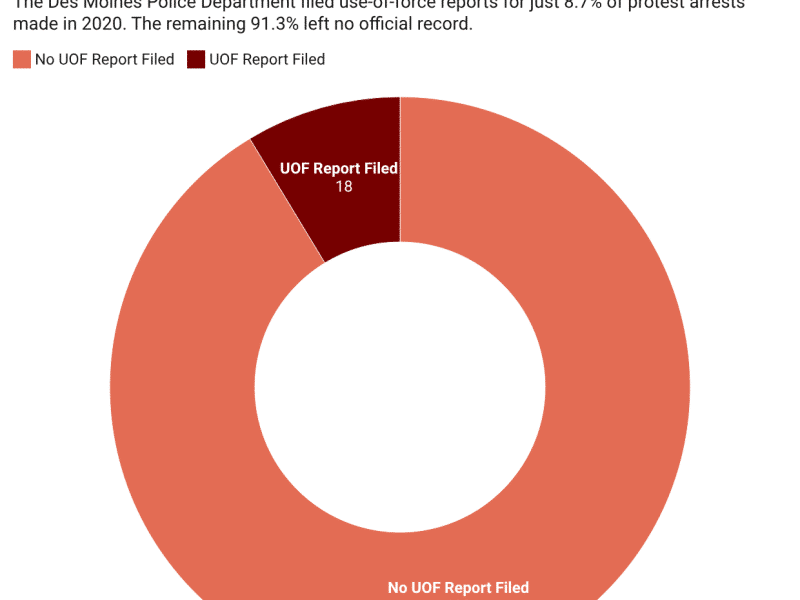
What the Numbers Caught: A Night of Force Tells All about the DMPD
ANALYSIS: Iowa nonprofit Just Voices releases study of Des Moines Police’ Use-of-Force Reports from the George Floyd protests.
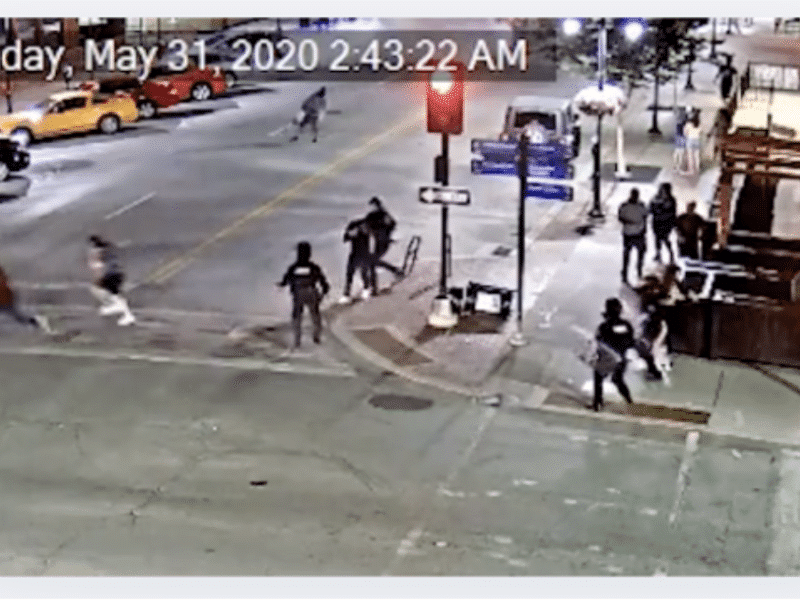
The Silence After the Sirens: What a Security Camera Revealed at 3rd & Court
A nonprofit dissected a surveillance video from the 2020 George Floyd protests, revealing allegedly undocumented use-of-force incidents by the DMPD.

‘Three Strikes’: New Iowa law enforced beginning on July 1
A new ‘3 Strikes’ law in Iowa will result in the disproportionate incarceration of Black Iowans and lead to new prison construction, officials have projected.