
Passing the Baton: Who will document the Black experience in Iowa for the next 250 years?
The Black Press has long documented the lived experiences of Black Iowans. Sustaining it into the future will require more.
As America commemorates 250 years of democracy, I find myself thinking not only about where our nation has been, but about who will document where we go from here.
More specifically, I have been asking a question about my adopted home state: Who will document the Black experience in Iowa for the next 250 years?
That question does not suggest that one newspaper, organization or individual owns that responsibility. Iowa has historians, universities, museums, churches, community organizations, journalists and families preserving important pieces of our history.
But history teaches us something else: If communities do not help document their own experiences, important parts of their stories can disappear.
For Black Iowans, one institution understood that responsibility more than 130 years ago.
From Timbuktu to Iowa: Preserving the Record
Centuries before newspapers, websites and social media, African societies understood the importance of preserving knowledge.
Timbuktu became an internationally significant center of scholarship, commerce and manuscript culture. Its surviving manuscripts remind us of something fundamental:
- People of African descent have never been without intellectual traditions, institutions or a history worth preserving.
- The challenge from generation to generation has been making certain that the record survives.
More than 130 years ago in Iowa, one Black institution accepted its part of that responsibility.
“Fear God, Tell the Truth, and Make Money”
The Iowa State Bystander was established in Des Moines in 1894 as a weekly newspaper serving Iowa’s African American community. Ten prominent African Americans established the Bystander Publishing Company.
Their motto was wonderfully direct: “Fear God, Tell the Truth, and Make Money.”
I love the honesty of that statement.
They were not ashamed to say they were running a business. They wanted subscribers. They wanted advertisers. They wanted the newspaper to succeed.
But they were also going to tell the truth.
Under publisher John Lay Thompson, The Bystander expanded its reach throughout Iowa. Thompson understood something else that remains relevant today: economics mattered.
He challenged businesses that wanted Black customers but were unwilling to support the Black newspaper with their advertising dollars. Think about that. More than a century ago, Black Iowa was already having a conversation about the relationship among consumers, businesses, media and advertising. We are still having that conversation today.
A Statewide Black Institution
Attorney and World War I veteran James B. Morris Sr. acquired The Bystander in 1922 and would lead the newspaper for approximately half a century.
Under Morris, The Iowa Bystander became much more than a Des Moines publication. It connected Black communities throughout Iowa with local, statewide and national news. During World War II, subscriptions exceeded 12,000 statewide.
Long before social media, smartphones, email newsletters or the internet, a Black-owned newspaper headquartered in Iowa had created an information network connecting Black Iowans throughout the state.
And it was not afraid of difficult subjects.
The Bystander challenged the Ku Klux Klan. It supported federal anti-lynching legislation. It documented Black military service, civil rights demonstrations, police confrontations, the Black Power movement and the assassinations of Dr. Martin Luther King Jr., Malcolm X and Medgar Evers.
But the newspaper also documented everyday Black Iowa — families, churches, businesses, accomplishments and community life.
That matters.
History isn’t composed only of famous events. History is also the record of ordinary people building extraordinary communities.
Black Iowa History Is American History
Sometimes even Iowans do not realize the magnitude of Black history that has occurred right here in our state. Consider Fort Des Moines.
In 1917, 1,250 African American college graduates entered officer training at Fort Des Moines. Ultimately, 639 received commissions as United States Army officers. Fort Des Moines also trained African American medical personnel.
During World War II, Fort Des Moines again made history as the first Women’s Army Auxiliary Corps officer-training center. Its first officer class included 40 African American women.
That isn’t simply Black Iowa history. That is American military history.
Then consider the legal profession.
In 1925, the National Bar Association was incorporated in Des Moines by 12 Black lawyers committed to justice and civil rights. The organization developed during an era when Black attorneys faced discrimination and exclusion within the American legal profession.
Today, the National Bar Association describes itself as the nation’s oldest and largest national network of predominantly African American attorneys and judges. A major national legal institution has roots right here in Iowa.
That is American legal history.
Then there was Johnny Bright.
In 1951, the Drake University football star suffered a broken jaw during the Drake-Oklahoma A&M football game. Des Moines newspaper photographers captured the attack in a remarkable photographic sequence that subsequently won the 1952 Pulitzer Prize for Photography.
Those photographs forced America to confront racism within college athletics.
That is American sports history.
And then there was Edna Griffin.
Before Rosa Parks, There Was Edna Griffin in Iowa In 1948, Edna Griffin and other Black Iowans were refused service at the Katz Drug Store lunch counter in downtown Des Moines.
Griffin fought back through protest, boycott and the courts.
Her confrontation was part of a longer struggle against discrimination at Katz that The Iowa Bystander documented. Griffin, John Bibbs and Kenny Walker later used the pages of The Bystander to encourage Black and white Des Moines residents to continue demonstrating against the store’s discriminatory practices.
Katz ultimately ended the discriminatory policy.
Edna Griffin later became a regular contributor to The Iowa Bystander.
Think about what that represents.
The newspaper documented history. The people making history helped write it. That is the power of a community documenting itself.
Black Iowa’s Influence Has Never Been Defined by Its Numbers
There is a lesson running through these stories: Black Iowa has never been defined by the size of its population. Its influence has repeatedly exceeded its numbers. And that influence did not stop in the twentieth century.
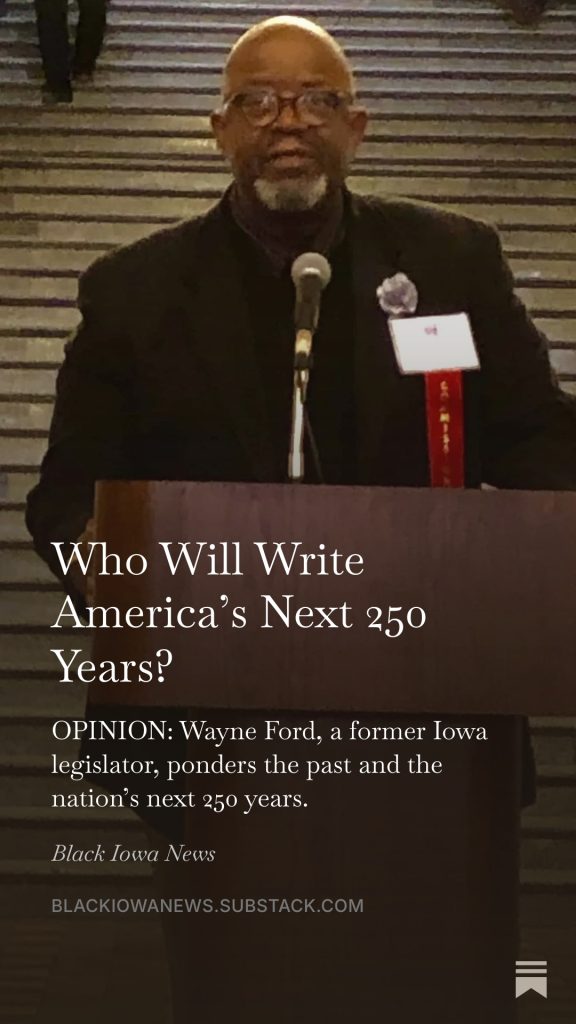
In 2008, Iowa became the first state in America to enact minority-impact legislation requiring analysis of whether proposed criminal-justice legislation would disproportionately affect specified minority populations. The concept subsequently traveled beyond Iowa, and federal legislation was later introduced based upon the Iowa approach.
Once again, an idea originating in Iowa entered a much larger national conversation.
The Baton Continued to Move
The Iowa Bystander passed through generations of ownership and stewardship. The Morris family’s long history with the publication was followed by other owners and publishers. Robert and William Morris edited the newspaper from 1979 to 1983. Later owners included Marshall Garrison, the Rev. Roderick Bradley and Jonathan Narcisse, who was among the publication’s later publishers.
Eventually, The Iowa Bystander stopped publishing. But the need it had filled did not disappear. The baton was still there.
A New Generation: Black Iowa News
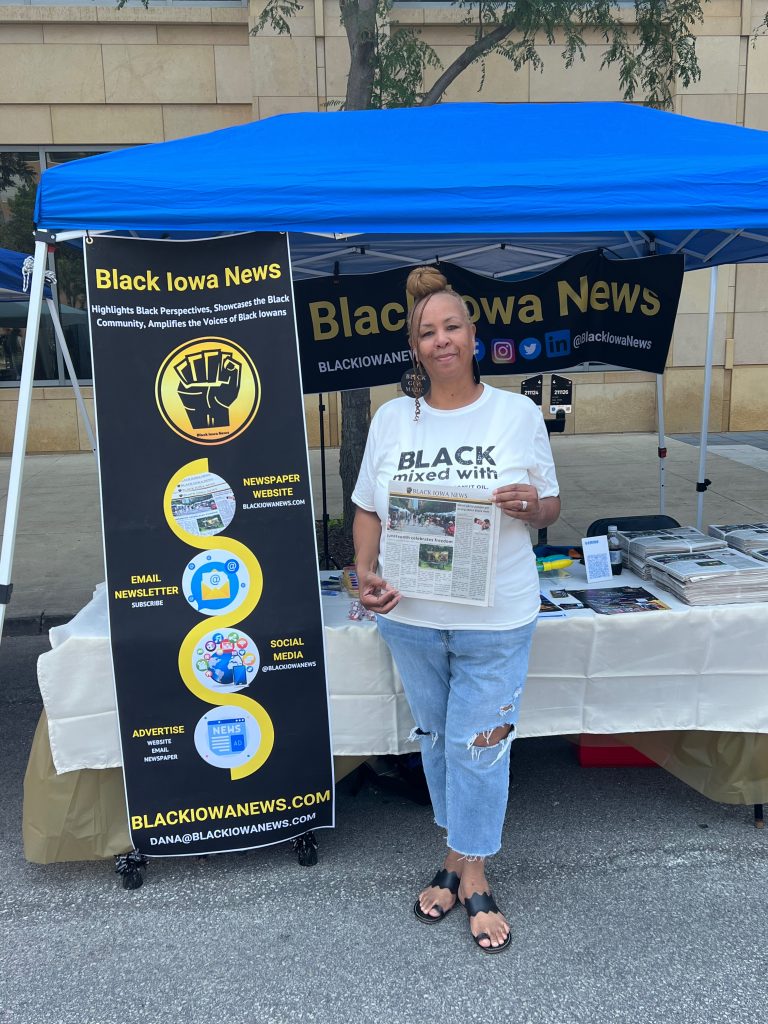
In May 2020, during the COVID-19 pandemic, journalist Dana James recognized another information gap. Statewide news organizations were reporting pandemic numbers, but James believed those numbers were not always being examined in ways that adequately showed Black Iowans what was happening within their communities. She created Black Iowa News to highlight Black perspectives, showcase Black communities and amplify Black Iowans’ voices. In 2023, she expanded that work by launching the print Black Iowa Newspaper.
Its motto: “Prioritizing, Educating and Uplifting Ourselves.”
Today, this is more than a printed newspaper. It is a multimedia information platform. Black Iowa News publishes online and through social media and email while distributing its printed newspaper statewide. Current information from the publication says the newspaper reaches more than 120 locations across 24 Iowa cities. It is also distributed in border states — Nebraska and Illinois.

That geographic footprint matters.
Black Iowa News should not be viewed simply as a neighborhood newspaper in Des Moines. It is a statewide Black Iowa communications resource. The subjects change. The responsibility does not. Look at what Black Iowa News documents today. Politics. Health. Education. Justice. Business. Arts and culture. Community life.
Its health journalism, for example, has examined Iowa’s serious cancer problem while specifically drawing attention to racial disparities affecting Black Iowans.
That demonstrates why specialized journalism matters.
Iowa has a cancer problem is one story. What Iowa’s cancer problem means for Black Iowans is another necessary story.
A legislature passing a bill is one story. “How could that legislation affect Black Iowans?” may be another. An election is one story.
“What are candidates saying about issues affecting Black communities?” is another.
Both belong in Iowa journalism.
A Focused Publication Does Not Mean a Small Reach
There is another reason we need to reconsider how we think about Black media in the 21st century.
The physical newspaper is no longer the boundary of the newspaper.
Dana James is an award-winning journalist and former Des Moines Register reporter. She has served as vice president and secretary of the Iowa Association of Black Journalists and has connections with broader Black journalism networks. Her journalism has also traveled beyond Iowa through digital publication and republication by news organizations in other states.
That matters.
A publication can have a focused mission and a relatively small staff while possessing a reach far beyond the physical copies sitting on newspaper racks. A story about Black Iowa published in Des Moines can be searchable online, shared electronically and encountered by readers far outside Iowa. That changes the meaning of the phrase “small newspaper.”
For corporations, advertising agencies and political campaigns evaluating communications opportunities, newsroom size alone does not tell you the value of a media organization.
- Look at its audience.
- Look at its credibility.
- Look at its digital presence.
- Look at its geographic distribution.
- Look at its community relationships.
And look at whether its journalism can travel beyond its original point of publication.
And it changes something else.
In the next 250 years, preserving our history will mean more than printing it. It will mean making certain our history is documented, searchable and accessible wherever future generations go looking for it.
I Have Written on Both Sides of This Bridge
There is a small personal connection for me as well.
Over the years, I had the opportunity to contribute guest commentary to The Iowa Bystander and occasionally found my own community and public-service work reflected in its pages. Today, I am grateful to continue that relationship with Iowa’s Black press as a contributing opinion writer for Black Iowa News. For me, that continuity is another reminder that publications and generations may change, but the responsibility to document Black Iowa continues.
The baton has been passed.
Iowa Is Changing America’s next 250 years will not look exactly like its first 250. Neither will Iowa. Iowa’s Black, Latino, Asian, multiracial, immigrant and refugee communities are part of a state that is becoming increasingly diverse.
That creates both a democratic question and a business question.
Who will communicate with these communities?
Who will document them?
And when corporations, advertising agencies, political campaigns, Chambers of Commerce, universities, nonprofit organizations and public institutions determine where to invest their communications dollars, will minority-owned media receive serious consideration?
This article is centered on Iowa’s Black press because that history deserves to be told.
But the principle is larger than Black Iowa.
Black, Latino and other minority-owned media should have an equal opportunity to compete for communications and advertising dollars based upon their journalism, audiences, reach, credibility and ability to connect institutions with the communities they seek to serve.
That is not charity.
It is not asking for preferential treatment.
It is market recognition.
Diversity Is Also a Marketplace
Iowa’s changing demographics are not only a social reality. They are an economic reality. Black, Latino, Asian and other increasingly diverse communities are consumers, homeowners, workers, entrepreneurs, taxpayers and voters.
- They buy automobiles.
- They buy homes and insurance.
- They purchase groceries, health care, technology and entertainment.
- They use banks and financial services.
- They start businesses.
- And they vote.
National research has documented the enormous and growing purchasing power represented by America’s increasingly diverse consumer markets. That does not mean placing an advertisement in a minority-owned publication automatically produces greater profits. No responsible publication should promise that.
But it does mean that businesses overlooking growing diverse audiences — and the trusted media organizations serving those audiences— may also be overlooking potential customers.
Advertising with minority-owned media should therefore be understood not simply as a diversity expenditure, but as a potential market-development investment.
There is also reciprocity in that relationship.
For generations, Black consumers have purchased products and services from companies that were not Black-owned and consumed media that was not Black-owned.
As Iowa becomes more diverse, it is nothing unusual to ask whether businesses seeking those consumers are also investing some of their communications resources in the media institutions serving those communities.
We are not asking Iowa businesses to value our institutions more than their own. We are asking them to recognize that our institutions have value too.
“Fear God, Tell the Truth, and Make Money” Still Matters
That brings us all the way back to The Iowa Bystander. Those Black publishers understood more than 130 years ago something that remains true in 2026.
Mission and business are not enemies.
A newspaper cannot preserve history if it cannot survive.
Journalism requires reporters, editors, photographers, printing, technology, distribution and time.
Political campaigns, corporations, advertising agencies, Chambers of Commerce, universities, nonprofit organizations and public institutions will collectively spend substantial amounts of money communicating with Iowans during the years ahead. As those decisions are made, Black-owned and other minority-owned media deserve the same serious consideration given to other credible media outlets.
Not because someone owes us something.
Not because somebody needs to check a diversity box.
And certainly not because we are asking for charity.
These media organizations reach consumers.
- They reach voters.
- They reach families.
- They document communities.
- They build relationships and trust.
- And they provide information about populations that institutions seeking to represent, employ, serve or do business with need to understand.
- If an organization seeks the votes, business, employment, trust or participation of Iowa’s increasingly diverse population, its communications strategy should reflect that reality.
- Inclusion is demonstrated not only by what institutions say.
- It is also demonstrated by where they invest.
- The Next 250 Years
- America’s first 250 years produced extraordinary progress, painful contradictions and unfinished work.
- Black Iowans were here.
- We served in America’s wars.
- We built businesses and churches.
- We became educators, doctors, attorneys, elected officials and community leaders.
- We challenged discrimination.
- We influenced American military history.
- We influenced American law.
- We influenced sports.
- We influenced civil rights.
- We influenced public policy.
- We raised families.
- We helped build Iowa.
- And Black journalists documented much of that journey when others did not.
The Iowa Bystander helped preserve that record for generations.
Today, Black Iowa News, along with others documenting Black life in our state, is helping create the record future generations will inherit.
One hundred years from now, someone may want to know what Black Iowans thought about artificial intelligence, education, criminal justice, health disparities, economic opportunity, presidential elections or the changing demographics of our state.
Where will they look?
Two hundred and fifty years from now, someone may ask what it was like to be Black in Iowa when America celebrated its 250th anniversary.
What evidence will we leave them?
Black history is Iowa history
And Iowa history cannot be complete if the Black experience is missing from the record.
The technology will change.
The newspapers may change.
The people holding the baton will change.
But the responsibility remains:
Tell the truth. Preserve the record. Build sustainable institutions. And make certain that Black Iowa is seen, heard and remembered throughout America’s next 250 years.
And for those seeking to communicate with the Iowa of tomorrow, there is one final question worth considering:
The next chapter of Iowa’s Black press will not be sustained by history alone. It will be sustained when readers, businesses, institutions and political campaigns recognize that preserving these voices — and reaching the communities they serve — has both civic value and economic value.
We are not asking institutions to invest in minority media because of what happened to us yesterday. We are asking them to recognize the consumers, voters, workers and communities that exist today — and the market that will exist tomorrow.
Can you afford to overlook the people — and the media institutions — already documenting it?
Cover: 📷 Getty Images
Related Articles

The Power of One Vote
Some Americans believe their vote cannot possibly matter. Others are frustrated with the government, disappointed with political leaders, or convinced that elections are decided long before they reach the ballot box.
Seated, Not Silent: Why I Choose Not to Stand for the Pledge
OPINION: Do you stand for the Pledge of Allegiance? Not everyone does. Read Lya Williams’ rationale for her decision.

The Iowa America Thought It Knew: Race, Democracy and a Record Worth Remembering
Iowa has a rich history of Black Iowans making an impact on politics locally and nationally, says a former Iowa legislator