
Native Iowans new book reveals ugly, criminal underbelly of a not-so-long-ago Des Moines through accounts of a notorious saloonkeeper
Native Iowans’ new book reveals the ugly, criminal underbelly of a not-so-long-ago Des Moines through accounts of a notorious saloonkeeper.
This piece first appeared in THE IOWA MERCURY.
Native Iowans new book reveals ugly, criminal underbelly of a not-so-long-ago Des Moines through accounts of a notorious saloonkeeper
JUL 15, 2026
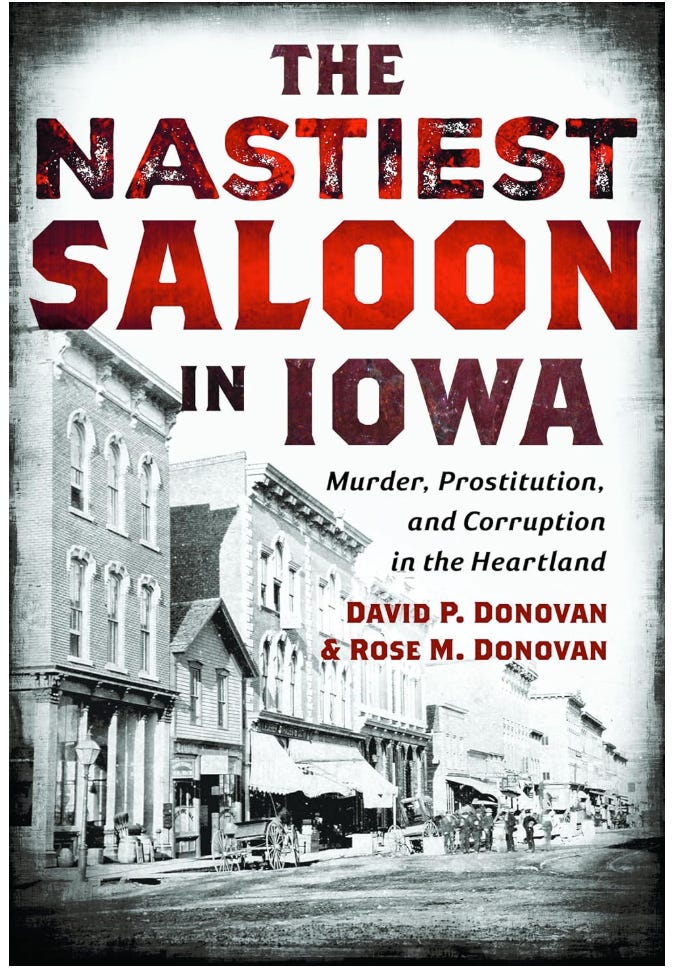
In an inviting and richly reported new book populated with larger-than-life figures cut from the fabric of everyday life in early 1900s central Iowa it is the City of Des Moines itself that emerges as the most riveting character.
David and Rose Donovan’s book, “The Nastiest Saloon in Iowa: Murder, Prostitution, and Corruption in the Heartland,” reveals details about early Des Moines that are shocking and scandalous, hilarious and haunting, and at times all of that on but a single page. The Donovans’ non-fiction work is now in bookstores and available online, and the couple, both accomplished journalists with deep Iowa roots, are making the media rounds to promote this roar of a read.
I moderated a conversation with the Donovans at Beaverdale Books.
“The Nastiest Saloon” centers on a bar-brothel operated by Rose Donovan’s great grandfather, Erastus Wallace Scott of Des Moines — who sadly dismissed his fitting given first name in favor of the middling “Wallace.” The bar, described in the media in 1908 as a “notorious saloon,” was ground zero on East Court Avenue for a range of criminal activity, and formed the core of what was an industrial-scale level of prostitution and booze-fueled corruption and cruelty.
“It tells a story of America that people in the Midwest don’t know,” David Donovan said.
Venereal disease, chiefly syphilis, described at the time as a “scarlet monster” ran so rampant in the state’s capital city that The Des Moines Register in 1908 reported that 80 percent of the deaths of women in Des Moines were caused by “social” diseases, and that 75 percent of the men in the city had been affected by STDs. The Donovans write about a “scarlet trust” of landlords and businessmen, brothels and bar owners, and others, that lured young women into prostitution and trapped them as “inmates” in houses of “ill fame” with punitive rents and interest and other fees, shackling them to lives of abuse until venereal disease killed them — or they committed suicide. The latter could be accomplished by “gulps” of carbolic acid, the book reports.
“Some things never change,” Rose Donovan said. “We have sex trafficking happening today.”
The Donovans spoke with The Iowa Mercury in the publication’s offices in Carroll, David Donovan’s hometown, and joined Julie Gammack on her Iowa Writers’ Collaborative podcast.
“I love your book, it’s very fact based,” Gammack said of “The Nastiest Saloon.”
The book’s roots were the results of the pursuit by the Donovans of information about Scott. Rose Donovan grew up in Des Moines with but whispers, little confirmed knowledge, about her family, and this most infamous of great grandfathers.
“It started as a forgotten family history,” Rose Donovan said.
Soon, the research and writing of this book rivered into a project revealing a dark underbelly of Des Moines, and Iowa itself, that had been lost to history.
“It’s not that long ago,” David Donovan said.
The book, much of it gleaned from newspapers, deals with high-profile murders in the early 1900s, and outrageous criminal schemes of theft and fraud, in addition to prostitution. Some of the defenses used in court are so outlandish that readers likely will laugh out loud, such as two defendants, who clearly paid witnesses to leave town, seeking relief because they did not see how this was a crime at the time in Iowa law. Some journalists in pre-1910 Iowa even gave alleged ghosts credibility in their news stories.
We learn in “The Nastiest Saloon” about a hucksters of epic audacity — Count Nathoo — “The Wizard Of The Nile” — who ran daring confidence schemes in Iowa, some of them out of a front called The Temple Of Psychology in Des Moines. His misconduct raged for two decades in the Midwest — and the media, remarkably, loved him for it at times even though few people in history took advantage of Iowa Nice as unapologetically as The Count. Author David Donovan correctly notes that a full book could be dedicated just to Count Nathoo, who is a blend of Harry Houdini and Bernie Madoff.
“The Nastiest Saloon,” written with verve and flair, and grounded in the reporting of the times by authors who understand journalism, is in the end, an accounting that holds a mirror to Des Moines as early fortunes that feed status of families today were built on the bodies of women imprisoned quite literally in prostitution. Yes, there are murders and confidence men in the book, but the haunting parts of this work are the accounts of shattered and destroyed lives of countless women on East Court Avenue.
That history, lost for more than a century, is alive again in our conversations because of the Donovans’ book.

About the Authors
David Donovan is a retired lawyer and amateur genealogist. He practiced law most of his career for an international firm based in the Washington, DC metropolitan area, and spent half a decade as general counsel for the Washington, DC NFL franchise. Rose Donovan is a retired journalist, having worked for decades as a reporter and editor for suburban newspapers in the DC area and later the Washington Post. They have three children and two grandchildren. David and Rose now live in a small town on the Eastern Shore of Maryland, not far from where Rose’s ancestors landed in America in the 1650s, and where David serves as a Town Commissioner. This is their first book. Both David and Rose graduated from Iowa State University, where they earned bachelor’s degrees. David is a Carroll native and alum of Kuemper Catholic High School. Rose is a native of Des Moines and an alum of Lincoln High School.

About The Iowa Mercury
(Douglas Burns, founder of The Iowa Mercury and a fourth-generation Iowa journalist from Carroll, is a member of the Iowa Writers’ Collaborative. Read dozens of the most talented writers in Iowa in just one place. The Iowa Writers’ Collaborative spans the full state. It’s one of the biggest things going in Iowa journalism and writing now — and you don’t want to miss. This collaborative is — as the outstanding Quad Cities journalist Ed Tibbetts says — YOUR SUNDAY IOWA newspaper. )
Author

Related Articles


African American Museum of Iowa honors statewide leaders in annual event
From athletes to state representatives, the History Makers event showcases Black excellence through various perspectives of leadership.
Iowa African Film Festival crowns first winners
Winners have been announced for a film festival featuring stories of Africa held in August in Des Moines.