
From Tax Bill to Tainted Waters: Why Mari Jo Mentzer is running for Iowa House District 15
Concerns about Iowa’s water quality, rising cancer rates and high taxes have prompted a woman from Missouri Valley, Iowa, to run as an independent for Iowa House District 15. The election is Nov. 3.
For two years, a sheet of pink construction paper hung on the refrigerator in a one-bedroom apartment. The words on it were written in crayon: “Fear of failure clips your wings. If you want to fly, you have to try.”
Marilyn “Mari Jo” Mentzer put it there for her son, who wanted to run hurdles even though he wasn’t very tall. It became the family’s mantra. Now she is living by it herself.

Mentzer, 61, is a Harrison County native, a licensed real estate broker, a mother of three and, as those close to her say, “tough as nails”. She raised her children largely on her own after leaving a difficult marriage. In 2020, she returned to Missouri Valley to care for her father through his cancer. He has since died and now, her mother is fighting cancer, too.
Those years taught her to stand up for herself and her family. Now, after a fight over her own property taxes led her to contaminated groundwater outside her hometown, she is standing up for her community, running as an independent for the open seat in Iowa House District 15.
“We’re paying high taxes and we still don’t have clean drinking water,” Mentzer said. “There’s a problem.”
Mentzer is one of four candidates for a seat a Republican has held for two decades, in a district that leans heavily Republican, with no party behind her. Although the stakes are high, she is running anyway, carrying the reminder of her upbringing and the support of people who helped her get to where she is. She grew up in Missouri Valley to blue-collar parents who worked hard all their lives, passing their values down to Mentzer and her brother.
“I just loved Missouri Valley. I spent my whole life there,” she says. “Never really ventured off too far until after I graduated from high school.”
After community college and a semester at Wayne State, where she joined the Catholic Church, she came home and married a local farmer. She hauled grain at harvest, raised three kids, led a 4-H club and coached soccer. But when the couple asked to buy the farmhouse they lived in, her in-laws refused and warned her that if anything happened to her husband, she and the children would have nowhere to go.
So she baked pies, saved the money and paid for her real estate license. That license became her way out. Her husband was struggling, and she watched it begin to affect their children.
“It got to the point where your kids are starting to notice that and talk about it,” she says. “It’s time to get your kids out of that situation. Sometimes you’ve got to make tough calls. So I made that tough call.”
She walked away with “three kids, a car and a couch and some clothes and a few toys.” For two years, the four of them lived in that one-bedroom apartment while she worked a full-time job and a part-time job, starting dinner in the crock pot each morning so the kids came home to a hot meal. She said she never applied for public assistance.
“I didn’t want my kids to have free lunch. I didn’t want my kids to see us on any kind of welfare programs. And there’s nothing wrong with that,” she says. “God knows our lives would have probably been easier. But I’m a very proud person, and we all just kind of pitched in.”
She later built a career in Omaha, first selling homes and then training new agents, and all three of her children earned college degrees.
“My kids did not grow up with any privilege at all, but they are extremely successful individuals now,” she says. “And I think it’s because you have to decide as a parent what kind of example you want to be.”
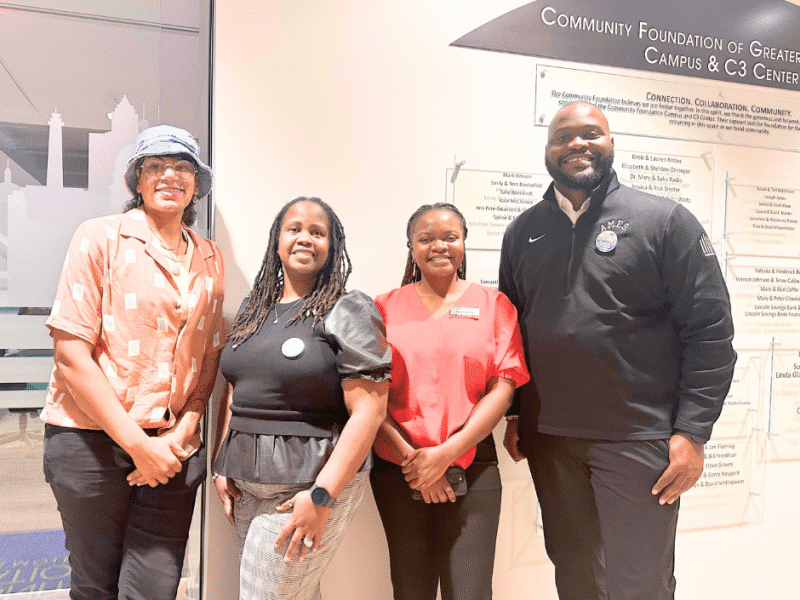
In 2020, in the middle of the pandemic, Mentzer remarried. Her husband, an Omaha native, was also raised by a single mother, and that year the couple moved back to Missouri Valley to be near her father as his health declined.
“He grew up with a single mom, and he had a really rough life,” she says. “He has given me the opportunity to do some things, like running for this campaign, that wouldn’t have been as easy.”
Running for office wasn’t on her mind yet, though. Within two weeks of buying their home, the county assessed it at $80,000 more than they had paid. Mentzer appealed and started attending Board of Supervisors meetings to understand why Harrison County’s property taxes are growing so much faster than the rest of the state’s. By one measure from Iowans for Tax Relief, the county scores 48.8, compared with 39.5 statewide.
At one of those meetings, a supervisor brought in a brochure about groundwater contamination southeast of town. The chemical was trichloroethylene, or TCE, a degreaser once used at a Cold War missile site and classified by the EPA as a human carcinogen. The contamination, she says, has spread from 289 acres to about 3,000.
The news hit close to home. Mentzer already knew Iowa has one of the highest cancer rates in the country, and that Harrison County ranks fifth among the state’s 99 counties. With both of her parents diagnosed, she had been searching for answers.
“I was born and raised in Missouri Valley. I have been here the majority of my life and had no idea that we had a water contamination issue on top of the nitrates,” she says. “Some people would probably tell you that I have become an expert on TCE. That was not intentional.”
Mentzer started making calls to the Iowa Department of Natural Resources and the U.S. Army Corps of Engineers, and eventually three Corps staff members spent two hours at her kitchen table walking her through the problem. Then she knocked on every door near the site, twice. She met families who can’t trust their wells, a veteran who can’t build a home on his land and neighbors living with cancer, brain tumors and Parkinson’s disease. Many had written to their elected officials for help. Few heard back.
“We have a lot of issues, and they keep getting swept under the rug,” she says. “So I’ve really been trying to make the Army Corps and the Iowa DNR and our local government accountable.”
What she learned pushed her into the race. In a county that is about 71% Republican, Mentzer is running without a party. She faces Republican Jason Sherer, Democrat Benjamin Schauer and fellow independent Blake Johnson.
“I’m not running as a candidate for Republicans or Democrats, because I feel like party leadership tries to dictate the conversation,” she says. “Running as an independent, I have the freedom to focus on the issues that are important to me. I can be true to myself and true to the people that I’m trying to protect. People don’t have to like me, but I hope they understand I’m trying to protect them, their children.”
She campaigns at county fairs, on Facebook and on doorsteps, and she has already seen progress. In June, Harrison County issued its first public statement on TCE, which residents can take to their doctors to ask for testing. Meanwhile, she is still fighting her own tax assessment without a lawyer, and she worries about the neighbors who don’t feel they can push back. More than anything, she wants voters to see themselves in her.
“I think the most important thing for people to remember is that I’m just a candidate. I’m not an elected official. I’m a private citizen just like them,” she says. “You have to be brave and use your voice. When something isn’t right, you need to speak out about it and not be afraid to use your voice.”
Whatever happens on Nov. 3, Mentzer believes the campaign has already made a difference.
“Whether I win or not is irrelevant,” she says. “I feel like I’m winning already, because we’re getting over some hurdles that people haven’t had any progress on since 2012.”
Years after she taped it to the refrigerator, the message on that pink paper still guides her: if you want to fly, you have to try.
Author

Related Articles

One week to go until the Nov. 3 Election: Here’s what seven Iowa candidates say they’ll do for Black Iowans if elected
Black Iowa News sent candidate questionnaires to 200+ email addresses on the Secretary of State’s 2026 candidate list. We received seven responses.
Republican Ronald Langston wants to bring his extensive public and private sector expertise to Iowa Senate District 17
Republican Ronald Langston is running for Iowa Senate District 17 in Des Moines. The election is Nov. 3.

Iowa agriculture secretary candidate Chris Jones would advocate for ‘environmental justice’ and farming opportunities for Black Iowans
Here are the responses from Black Iowa News’ Candidate Questionnaire. Seven candidates completed the questionnaire. Here’s where they stand on the issues that matter to Black Iowans. The election is Nov. 3.