
When the NAACP asks Black athletes to boycott: Connecting the dots —scholarships, NIL, protest and political power
Should Black athletes boycott public universities in the states “attacking” Black voting rights? Wayne Ford analyzes the issue.
There are moments in American history when sports become larger than sports.
Sometimes athletics becomes a stage for patriotism. Sometimes it becomes a stage for protest. Sometimes it becomes a stage for race, economics, politics and national division all at once.
America may be entering another one of those moments now.
Recently, the NAACP called upon Black athletes and supporters to reconsider participation in states where political redistricting and voting-map decisions are being challenged as unfair to minority communities. The request immediately generated strong reactions throughout the sports world, political circles, universities and Black America itself.
The NAACP asked athletes, fans, families and alumni “to withhold athletic and financial support from public universities in states that have moved to limit, weaken, or erase Black voting representation in the wake of the Supreme Court’s 6-3 ruling in Louisiana v. Callais, which gutted what was left of the Voting Rights Act. The NAACP identified eight priority states — Tennessee, Louisiana, Alabama, Florida, Mississippi, South Carolina, Texas, and Georgia — and targeted flagship public athletic programs generating more than $100 million in annual revenue that continue to recruit Black athletes while their state governments dismantle the political power of Black communities.”
Some praised the request as courageous and historically necessary. Others questioned whether college athletes—many of them barely out of high school—should be asked to sacrifice scholarships, educational opportunities, or even multi-million-dollar NIL agreements because of political decisions made in state capitols and courtrooms.
I am not writing this article to criticize the NAACP. Nor am I questioning the sincerity of those who support athlete activism. People have the right to protest. People have the right to organize. People have the right to challenge systems they believe are unfair.
But I also believe America has the responsibility to ask difficult follow-up questions. As the founder and executive director of the Wayne Ford Equity Impact Institute and a former college athlete, I believe this moment deserves more than emotion alone. It deserves context. It deserves history. It deserves institutional analysis. Because many times in America, especially across generations, we fail to connect the dots.
Those of us from the Baby Boomer generation are now entering what many would call the winter of our lives. Many younger Americans inherit emotional moments, headlines, protests, slogans and political division without always receiving the historical context that explains how we arrived at where we are today.

Sometimes that is because institutions themselves failed to connect the dots.
That, in many ways, is one of the missions of the Wayne Ford Equity Impact Institute: to help connect the dots so future generations have stronger points of reference than many of us had growing up. Not simply points of reference based on race alone, but points of reference connected to economics, governance, opportunity, history, institutional power and long-term outcomes.
Because when people lack historical context, society develops gaps in understanding. And eventually those gaps become divisions.
I know personally what an athletic opportunity can mean.
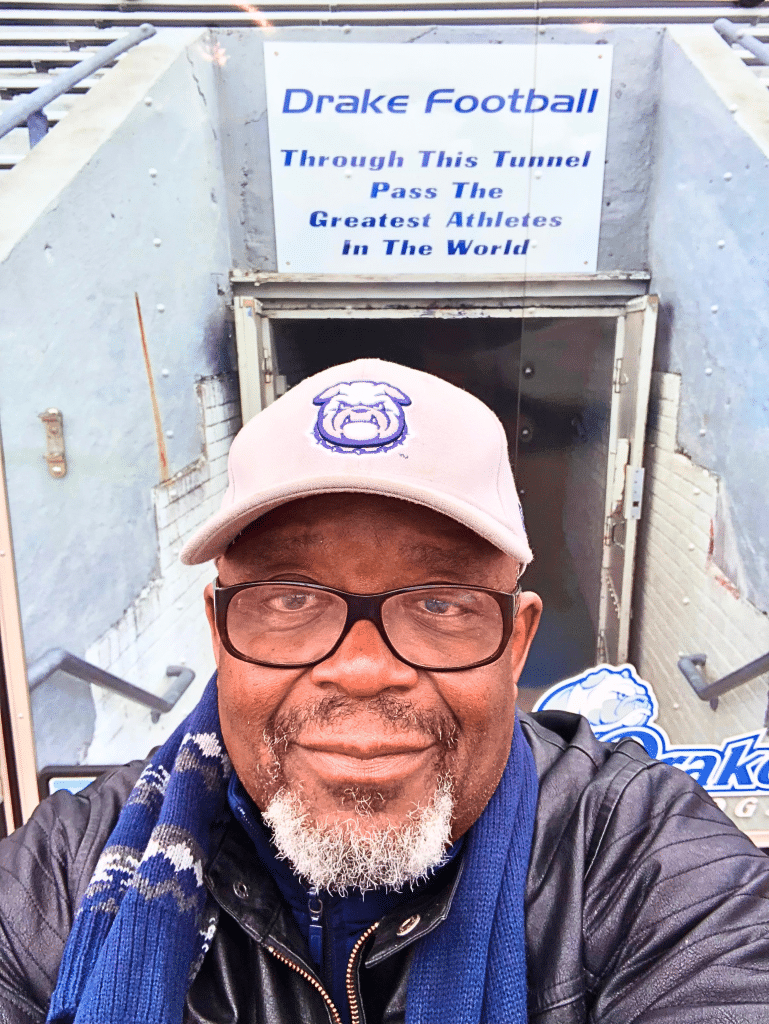
I grew up in Washington, D.C., during one of the most turbulent racial and political periods in modern American history. Football helped carry me from Washington, D.C., to Rochester, Minnesota, and eventually to Drake University in Des Moines, Iowa, through a football scholarship that changed the course of my life. Looking back now, I owe everything in my life to Almighty God first, my family second and football third. Football was not simply a game to me.
Football became a bridge
Football carried me across the country to Drake University through a scholarship. That opportunity eventually helped me become a legislator, founder of Urban Dreams, co-founder of the Brown & Black Forums of America, founder of the Wayne Ford Equity Impact Institute, a radio and television voice, consultant and author of Iowa’s racial impact statement legislation.
I am only one example among many.
Across America, athletic scholarships helped create doctors, teachers, military veterans, business leaders, pastors, nonprofit leaders and public servants from both Black and white working-class communities. For many families, athletics became one of the few available bridges toward higher education and economic mobility.
That reality deserves discussion, too.
From boxing to football: Sports as a pathway out
Years ago, boxing was often viewed as one of the few available paths out of poverty for poor whites, immigrants and poor Black Americans alike. Over time, football and basketball became similar pathways. Athletics represented a way out for many families. Many athletes used the structure, discipline, exposure and education sports provided to build lives far away from their circumstances. That reality crossed racial lines.
There are countless Black Americans whose lives changed because someone gave them an athletic opportunity. There are also countless white Americans whose lives changed because they received scholarships and opportunities they otherwise may never have received. Sometimes in America, we become so focused on racial separation that we forget certain institutions historically became ladders for many struggling people, regardless of race. But, that does not erase racial inequities.
But it does help connect the dots more honestly.

From Muhammad Ali to the NBA Bubble
Black athletes have long played an historic role in American protest movements.
When Muhammad Ali refused military induction during the Vietnam War era, he knowingly sacrificed years of his career and millions of dollars. When Jim Brown, Kareem Abdul-Jabbar, Bill Russell and others publicly supported Ali, they understood the personal and professional risks involved.
But history must also remember an important distinction: most of those men were already professionals. They had contracts. They had income. They had public stature. They had already crossed into another level of economic security and influence.
College athletes occupy a very different reality.
An 18-year-old freshman from Alabama, Mississippi, Louisiana, Georgia, Florida, or Texas may not simply be playing football. He may be carrying his family’s hopes, educational opportunities, economic mobility, healthcare access, networking opportunities and now potentially NIL earnings capable of changing his family’s financial future for generations.
Years later, after the killing of Trayvon Martin, the Miami Heat famously wore hoodies in solidarity. During the NBA bubble following the police shooting of Jacob Blake, players considered boycotting games entirely. Reports later confirmed that Barack Obama spoke with LeBron James and other NBA leaders regarding how players could strategically use their influence.
Those moments mattered. They raised awareness. They reflected moral outrage. They forced conversations.
But years later, another question remains: What measurable institutional changes followed? Did ownership structures significantly change? Did governance structures significantly change? Did long-term economic participation significantly change? Or did America simply experience powerful emotional moments before moving on to the next crisis?
These are not cynical questions. They are historical questions.
The NIL era changed everything
There is another reality America must confront honestly. Today’s college athletes are operating in an entirely different financial environment than previous generations. Under modern NIL policies, some student-athletes can now legally profit from their name, image, and likeness. For some athletes, NIL opportunities now involve six-figure contracts, national endorsements, family support, housing assistance and financial security that previous generations of college athletes could barely imagine.
That changes this conversation significantly. An athlete considering protesting today may not simply be sacrificing a season. He or she may be sacrificing educational opportunity, economic mobility, family stability and potentially generational wealth. This becomes especially important because many college athletes still come from working-class communities, underfunded school systems, or families struggling economically.
As someone whose own life changed because of athletics, I cannot casually dismiss the seriousness of asking a young person to walk away from those opportunities.
That does not mean protest is wrong. It simply means the stakes are real.
The question that may make America pause
Sometimes in America, one question can change an entire conversation. This may be one of those questions. I sometimes ask myself: What if the political roles were reversed?
What if conservative white athletes believed progressive-controlled states were drawing voting maps in ways conservatives believed unfairly protected Democratic political power? Would conservative organizations encourage white athletes to boycott universities in blue states?
That question is not designed to provoke anger. It is designed to test consistency.
Because throughout American history, who draws political maps often depends on who controls the governor’s office, who controls the state legislature, who controls the House and Senate within a state and which political party currently holds power. In some states, Republicans control the process. In other states, Democrats control the process. In many cases, redistricting battles become intensely partisan regardless of race.
That reality does not eliminate concerns about fairness, race, or representation. But it does raise larger democratic questions about political power, institutional incentives and whether principles remain consistent when power changes hands.
Sometimes the best way to test the fairness of a political principle is to reverse the roles and ask whether we would still support the same action if the political power structure were different.
That is not confrontation. That is democratic inquiry.
The unfinished question of ownership
There is another difficult question America rarely discusses deeply enough. Black athletes have helped build modern sports culture in America. Black athletes helped transform college football, college basketball, the NBA, the NFL, Olympic sports and billions of dollars in sports-related media value.
Yet ownership remains remarkably limited. Currently, the National Football League has no Black majority owner. Major League Baseball has no Black majority owner. And while Robert L. Johnson, who founded BET, became the first Black majority owner in the modern NBA era, he later sold his controlling stake in the Charlotte franchise to Michael Jordan, and Jordan sold his ownership in 2023.
This raises larger institutional questions. Who owns the systems? Who controls franchise valuation? Who controls media contracts? Who controls stadium financing? Who controls succession planning? Who benefits most from generational sports wealth?
These are not anti-American questions. They are accountability questions.
Beyond emotion
Perhaps that is the larger issue confronting America now. Emotional moments matter. Symbolic moments matter. Athlete activism matters. But eventually America must also confront governance, ownership, institutional power, generational wealth, and structural participation.
Before America asks a young athlete to sacrifice everything, America should also be willing to discuss who controls the systems.
Maybe this moment is bigger than sports. Maybe it is really about democracy itself: who participates, who governs, who profits, who sacrifices and who ultimately owns the future.
I do not claim to have all the answers. But I do believe America deserves the right to ask the questions. And sometimes the questions themselves may force us to think more deeply than the slogans.
Read more about the NAACP’s Out of Bounds campaign.
Correction: An earlier version of this story contained an error about the ownership of the Charlotte Hornets. We apologize for the error.
Cover art: Getty Images
Related Articles

The Iowa America Thought It Knew: Race, Democracy and a Record Worth Remembering
Iowa has a rich history of Black Iowans making an impact on politics locally and nationally, says a former Iowa legislator
What the Numbers Caught: A Night of Force Tells All about the DMPD
ANALYSIS: Iowa nonprofit Just Voices releases study of Des Moines Police’ Use-of-Force Reports from the George Floyd protests.
OPINION: The Problem With Black Women
The headline may make you uncomfortable. It should. Sometimes the best way to expose a myth is to state it plainly, then dismantle it piece by piece.