
The Silence After the Sirens: What a Security Camera Revealed at 3rd & Court
A nonprofit dissected a surveillance video from the 2020 George Floyd protests, revealing allegedly undocumented use-of-force incidents by the DMPD.
Black Iowa News has published exclusive articles from Just Voices about the 2020 George Floyd Protests and the People’s History. Here is the latest piece:
Part 2
What does justice look like in our community, and will you join the work of speaking truth to power?
Just Voices has not been able to identify the civilians or the police who appear in the video that we examined in our previous essay. If you were a part of these incidents, or can identify people who were involved, please contact Just Voices with your information at info@justvoicesiowa.org.
At 2:43 a.m. on May 31, 2020, the intersection of 3rd & Court Avenue was a flashpoint for undocumented and unreported use of force encounters initiated by the Des Moines Police Department. In the first essay of this series, “Bearing Witness”, we raised up the encounter initiated by the Des Moines police with a bald man wearing a white T-shirt and Bermuda shorts. If you have watched the video, you will have observed, in the opening seconds, that the scene appears relatively calm. The intersection is quiet. It is absent from visual markers commonly associated with unrest or riotous activity. (For the purposes of this essay the video has been slowed down from the original timing to showcase the events as they occurred.) (video link here)
As the camera’s gaze shifts away from the bald man on the north east corner and looks further west along Court Avenue, the camera captures additional incidents of force by the Des Moines Police Department. A series of incidents occurring in less than one minute mirror the patterns of escalation and institutional silence, already documented in the prior essays of the “Peoples History.”
The first moments of the video show four police officers who are immediately identifiable at the bottom of the frame on the east side of the intersection. They appear to be stationed casually near the corner. Farther west, several individuals who appear to be civilians are seen hastily moving away from the area. While it appears that police may be pursuing some of these individuals, the footage alone provides no indication of why this pursuit is occurring or what precipitated it. The absence of any reports from the police, body camera footage and arrest record leaves the actions observed without explanation, justification, or accountability. (Arrows have been added to the footage to draw attention to the incidents being described)
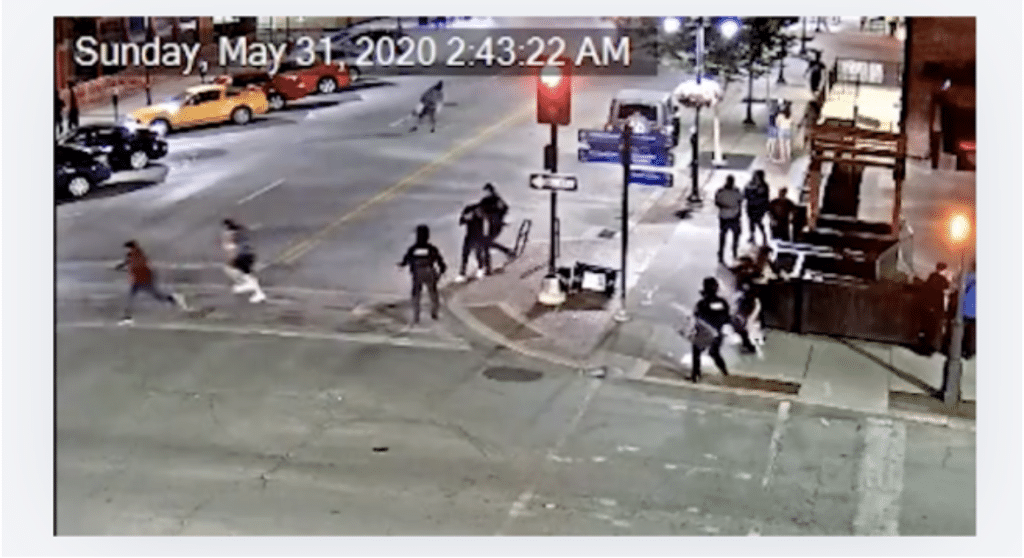
Within seconds after the start of the video, directly beneath a red stoplight, we observe an officer launching pepper spray at two people running across Court Avenue to the south. The spray does not appear to hit them.
Simultaneously, a person attempts to run north across the street. An officer grabs the individual, deploys pepper spray and then releases them before running off, seemingly in pursuit of others fleeing the scene. The person who was sprayed clutches their face and circles back toward the sidewalk, visibly affected by the chemical agent.
Concurrently, three people are seen walking east along the sidewalk when they are approached by an officer. One individual appears to raise their hands in the air. Despite this, an officer sprays them. The person immediately collapses to the ground. At the same time, another officer approaches a second individual from the east and appears to deploy spray.
At this point in the video, the escalation by the police is unmistakable. An unidentified officer is observed kicking the young man who has already been sprayed and is lying on the ground. Despite the presence of multiple officers on scene, no other law enforcement intervenes. Two additional people stand behind the individual being kicked with their hands raised, yet no effort is made by the police to stop the assault or to de-escalate the situation.
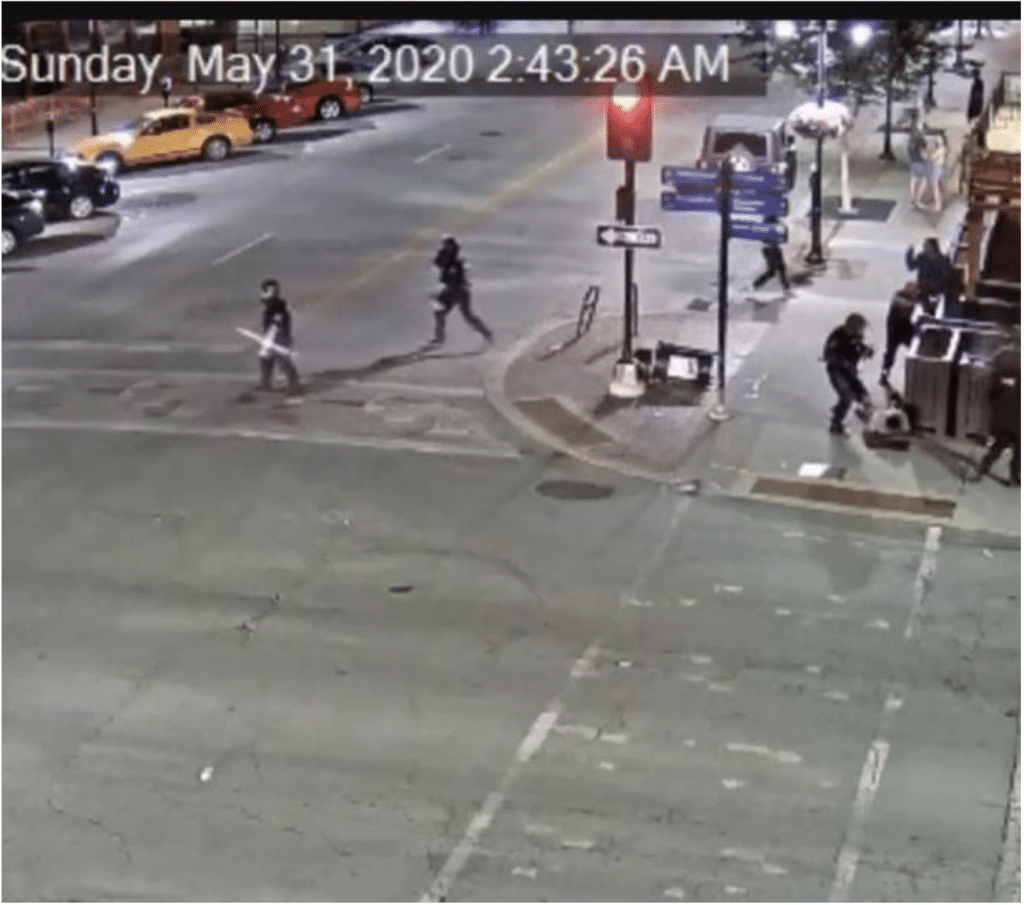
In the next frame, the young man rolls and gets to his feet. As he crosses the street, running to the east, a gas canister lands directly in front of him. Almost immediately afterward, a white police vehicle drives past the scene. The likely source of the canister.
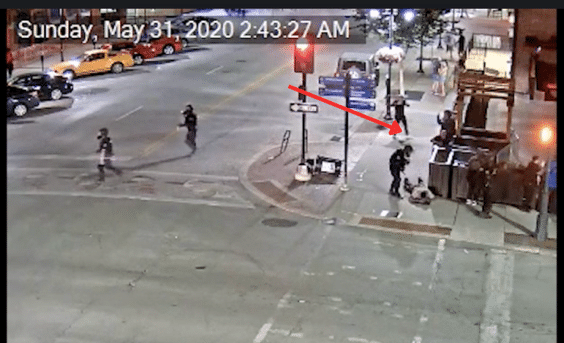
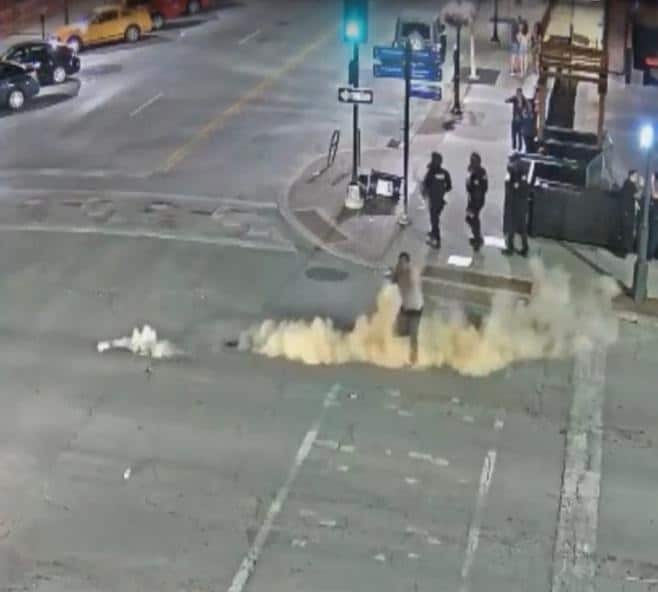
Within the same sequence, another young person enters the frame from the south. The individual who turns the corner is not addressed by police and appears to briefly enter an enclosure, exit it, retreat inside and eventually emerge again.
At the same time, another citizen wearing a white T‑shirt, pants, and white shoes walks along the same corner and turns north onto 3rd Street. The individual who previously had their hands raised is now seen walking with the person who had entered the enclosure, crossing Court Avenue together.
The incident concludes with officers returning to look briefly at the bald man on the east corner and walking away. No medical assistance or aid appears to be offered. The bald man eventually walks away to the east.
Meanwhile, the individual who had entered the enclosure is seen sitting calmly on a nearby bench.
The National Institute of Justice Commentary on the Use of Force
The National Institute of Justice (NIJ) provides a framework, described as a Continuum of Force, that is helpful in highlighting the severity of what the camera has shown us:
“Law enforcement officers should use only the amount of force necessary to mitigate an incident, make an arrest, or protect themselves or others from harm. The levels, or continuum, of force police use include basic verbal and physical restraint, less‑lethal force, and lethal force.”
According to the NIJ, force is intended to “mitigate an incident” or “make an arrest.”
The DMPD General Order in effect at the time of the protests provided the following guideline: “Reasonable Force” is that force and no more which a reasonable person, in like circumstances, would judge to be necessary to prevent an injury or loss…”
So far, Just Voices Iowa was able to determine:
There is no indication that any police officer, or civilian, was in any need of protection from any immediate threat of injury, harm or loss;
No arrests were made on any of the people who were assaulted by the police during the video;
No body camera footage was reviewed by the Des Moines Police Department;
No Use of Force Reports were filed concerning any of the actions observed in the video;
No Incident Reports were filed;
There is no record that any of the people assaulted by the police had any weapon;
There is no record that any of the people assaulted by the police had caused any damage to property;
There is no evidence that any of the people assaulted by the police had violated any law; and
There is no evidence that any officer who engaged in the conduct shown in this video was held accountable for their actions.
Key Takeaway: There would have been no record of these incidents but for the video captured by the security camera. Despite clear evidence of physical violence and chemical deployment captured on video, no arrests were made and no official reports were filed, leaving the use of force beyond the reach of institutional oversight and accountability.
Conclusion: Transforming the Lived Reality
The events at 3rd & Court Avenue serve as a stark reminder that accountability must be demanded, not assumed. Human dignity and constitutional rights cannot remain abstract ideals; they must be the standard against which all policing is measured.
To transform policing, we must confront the gaps between policy and practice. Accountability is not granted by institutions — it is enforced through public scrutiny and collective insistence. As viewers process this footage and the silence that follows, the question remains: What does justice look like in your community, and will you join the work of bearing witness to the truth?

Author
Related Articles
What is Black Iowa News?
We get this question a lot. How is Black Iowa News different from other news outlets?
Nov. 3 Election Nears
On Nov. 3, Iowans will head to the polls to make their choices known.

Seated, Not Silent: Why I Choose Not to Stand for the Pledge
OPINION: Do you stand for the Pledge of Allegiance? Not everyone does. Read Lya Williams’ rationale for her decision.