
The People’s History: The First Weekend of Protests – From Calm to Chaos
EXCLUSIVE: New article series from Just Voices chronicles the first weekend of protests during the summer of 2020 in Des Moines.
Editor’s Note: Protests held in the wake of George Floyd’s murder changed the world. This must-read series about the protests in Des Moines is researched and written by Just Voices, which is part of a movement to end racial profiling by the police. The series appears exclusively in Black Iowa News. (The views and opinions expressed in this series are solely the authors and do not necessarily reflect the views of Black Iowa News.)
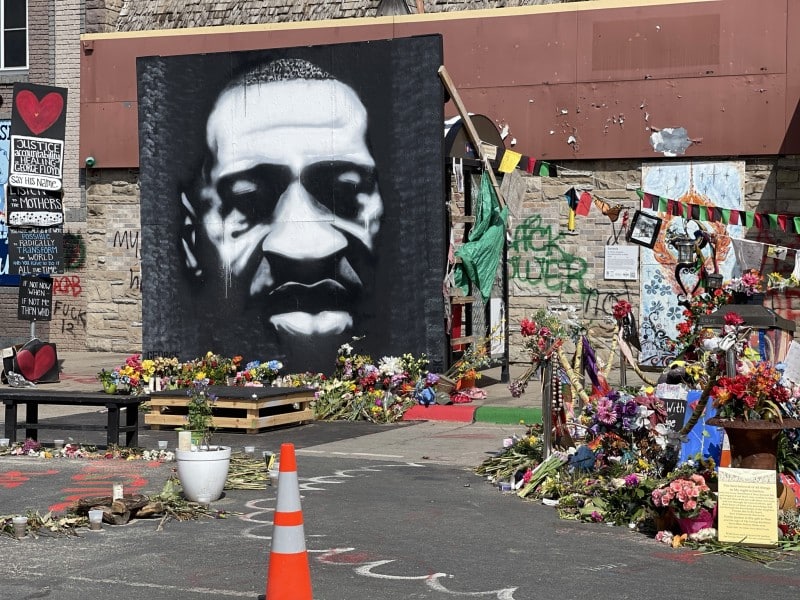
On May 25, 2020, George Floyd, a 46-year-old African-American man, was murdered by police officers in Minneapolis, Minnesota. A clerk at a convenience store had called 911, claiming that Floyd had purchased cigarettes with a counterfeit $20 bill. Police arrived and, after a struggle, forced Floyd to the ground. Officer Derek Chauvin pressed his knee into Floyd’s neck for more than nine minutes, killing him.
The immediate aftermath to Floyd’s murder was eerily quiet in Des Moines. While there was a great deal of chatter on social media, no organized response occurred until May 29. The first weekend of protests in Des Moines started calm, but ended in unnecessary chaos. The first recorded protest started at 6 p.m. at the Des Moines Police Station along the Des Moines River. Mike Turner was reported to have organized this gathering. It was estimated that more than 1,000 people attended. They listened to a series of speakers that included B.Well, Movement 515 and U.S. Senate Candidate (D) Kimberly Graham, among others. The rally peacefully ended, and Turner asked attendees to disperse peacefully. Most did.
A striking aspect about this gathering is the absence of a visible police presence. The photographic and video records of this event clearly record the anger that Floyd’s murder brought to the surface.
The event was non-violent. But what followed was not.
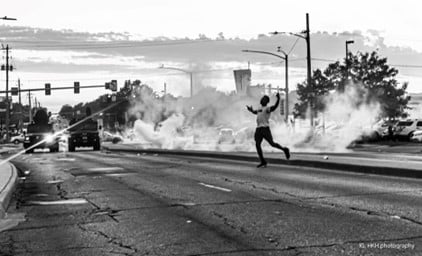
Allan Tunks, the assistant police chief made this statement in a legal deposition:
“… Friday was a unique event for us. It started off with a peaceful protest in front of the police station, and then the — I think it was a Roosevelt student maybe that organized that, and he spoke to us, somebody within our building, and said, “This is my plan, and at a certain time I’m going to shut it down, and then everybody will leave.” Well, some people left, and some people chose to stay, and the people that chose to stay are the ones that attacked the police officer that was at the Second and Court location.”
This was the beginning of the violence and vandalism. Over the course of the weekend, multiple protests broke out across the city. Most were non-violent. The events included:
· The Mothers March Against Violence – May 30, 1 p.m.;
· The Polk County Courthouse – May 30, 10:30 p.m.;
· The Des Moines Police Department – May 30, 6 p.m.;
· The East Village – May 30, 7:30 p.m.;
· Merle Hay and Douglas Avenue – May 31, 11 p.m.
· Water St., – May 31, 12:20 a.m.;
· Court Avenue, – May 31, 2:30 a.m.;
· Merle Hay Mall – May 31, 7 p.m.;
· The Des Moines Police Department – May 31, 9 p.m.;
The response of the Des Moines Police Department became progressively more militarized and violent, utilizing weapons such as teargas, rubber bullets and mass arrests.
Charges Filed
The records for the period from May 29 through midnight on May 31, show that 71 individuals were arrested and charged with 118 individual offenses. The charges that were filed included:
· Disorderly Assembly
· Criminal Mischief
· Disorderly Conduct
· Failure to Disperse
· Unlawful Assembly
· Participation in a Riot
Results of Charges Filed
The results of the charges were:
· 45 were summarily dismissed by the Court with no trial;
· 24 people entered a voluntary plea of guilty to some charge;
· 44 of the arrest records showed nothing beyond the initial filing of a charge;
· 2 cases are unaccounted for;
· 2 cases went to trial before the Court and were dismissed;
· One case was presented to a Jury and dismissed by the Jury;
· Derek Tyree Fuller was charged with Assault, tried his case to the Judge and was found Guilty.

Why Most Charges Failed in Proceedings
The reason for the summary dismissal of 45 charges and the expungement of 46 more was straightforward: The arrest records were not properly prepared. The actual arresting officer reported on the complaint form was, in most cases, not the actual officer making the arrest. On June 10, an email from Jeff Noble of the County Attorney’s office described it this way:
“As you probably know, all of the protest-related arrests were put under a single case number (20–14678), so deciphering what was originally provided to us as a 273-page file for this particular night has been a challenge, but a name search does not reveal any report specifically documenting what these defendants did.”

When the initial protest at the police station disbanded, an estimated 200 people remained around the police station. The first reported incidence of property damage occurred during this evening. Arrests began during the nighttime hours as the protests continued into the evening and night.
The First Recorded Booking That Weekend
The first recorded booking occurred on May 30 at 1:06 a.m. in the morning, when James Lee Vivian IV, was booked for Disorderly Assembly. The case was filed as a violation of the Des Moines. Municipal Code Section 70-31. The complaint that was filed with the Court stated that the full extent of Vivian’s crime was that he “Assembled downtown Des Moines during a riot.” The charge was a simple misdemeanor.

Vivian was arrested at 11 p.m. on the 29th and taken to the Polk County Jail. After being booked at 1:06 a.m. on the morning of the 30th, he appeared before District Associate Court Judge, Gregory D. Brandt, a little after 10 a.m. that morning. Vivian agreed to proceed without an attorney and pleaded guilty to the charges. The Court accepted his plea and entered the following ruling:
On inquiry, no legal cause has been shown to prevent sentencing on this date. Defendant was given an opportunity to speak in mitigation of the sentence. The following sentence is based on all of the available SENTENCING CONSIDERATIONS set out in Iowa Code section 907.5 The court finds the following factors the most significant in determining this particular sentence:
· Nature and circumstances of the crime.
· Defendant’s criminal history
Defendant is adjudged guilty of the above charges and is sentenced as follows:
Defendant shall pay a fine of $500 and applicable surcharges. (The total came to $735.)
Vivian’s history showed that he was a 33-year old Black male who had been arrested and charged 10 times before the evening of May 29, 2020. All of the arrests and charges against Vivian were low-level misdemeanors, such as driving a vehicle while barred from doing so and low-level marijuana possession.
Another person arrested during the first weekend was Sean Michael Robinson. Robinson is a Black male, then age 29. The original complaint filed on June 1, 2020, stated the following about the charges against Robinson:
On or about the above-stated date and time (5/31/2020 – 3 a.m.) the defendant did willingly join in or remain a part of an unlawful assembly, by assembling with multiple other persons in a violent manner, with the intent that they or any of them will commit a public offense, knowing or having reasonable grounds to believe it to be such.
Robinson took his case to trial before Judge David M Erickson, Magistrate. On April 22 of 2021, Judge Erickson issued an Order stating the following:

The State has failed to prove that the Defendant has committed a crime under Iowa Code section 723.2 and 723.3, beyond a reasonable doubt. The court finds the Defendant Not Guilty on both counts. Costs are assessed to the State.
In entering this ruling, Judge Erickson made the following findings about the evidence that had been presented to the court:
The State has failed to prove beyond a reasonable doubt that there was a riot or unlawful assembly at the Iowa State Capitol or that the command to disperse was given. The video offered into evidence by the State also indicates that the command to disperse was not audible. Proof that the Defendant heard the command was not proven beyond a reasonable doubt. The evidence presented to the court by the State did not prove that the Defendant did not leave the area in a reasonable amount of time.
The evidence presented by the State does not prove the defendant acted in a violent manner or joined an unlawful assembly, knowing that it was an unlawful assembly. The video and photos indicate the Defendant was in the area of an unlawful assembly but the Defendant was not acting in a violent manner. There is no evidence that the Defendant knew there was an unlawful assembly.
In other words, the Prosecution’s evidence failed to demonstrate any crime having been committed by Robinson.
The utilization of mass arrests coupled with inadequate recordkeeping led to summary dismissals (45 cases), a failure to successfully prosecute (2 cases); and the expungement of 45 cases. Upon our review, only one case that went to trial ended with a guilty verdict.
Expert Report Spotlights Flaws in Police Response Nationally
In February 2022, the Police Executive Research Forum (PERF) published a report titled “Rethinking the Police Response to Mass Demonstrations: 9 Recommendations”. This 53-page report serves as an excellent mirror to reflect on the “failures” of the Des Moines Police Department during and after the protests of 2020, in the opinion of Just Voices Iowa. The report affirms the conclusions of The People’s History essays that the Des Moines Police Department was not prepared for what happened after the murder of George Floyd. It challenges the utilization of less-than-lethal force as it was used by the Des Moines Police Department. It stresses the need for police departments to build a wide range of relationships with community leadership in new and more encompassing ways. And, it describes the events of that summer in the following manner: “The demonstrations of 2020 are a wake-up call for American police agencies”
Related Articles

Polk County to launch its first warrant resolution clinic
The CJCC joined forces with various organizations to help Polk County residents resolve their non-violent warrants.
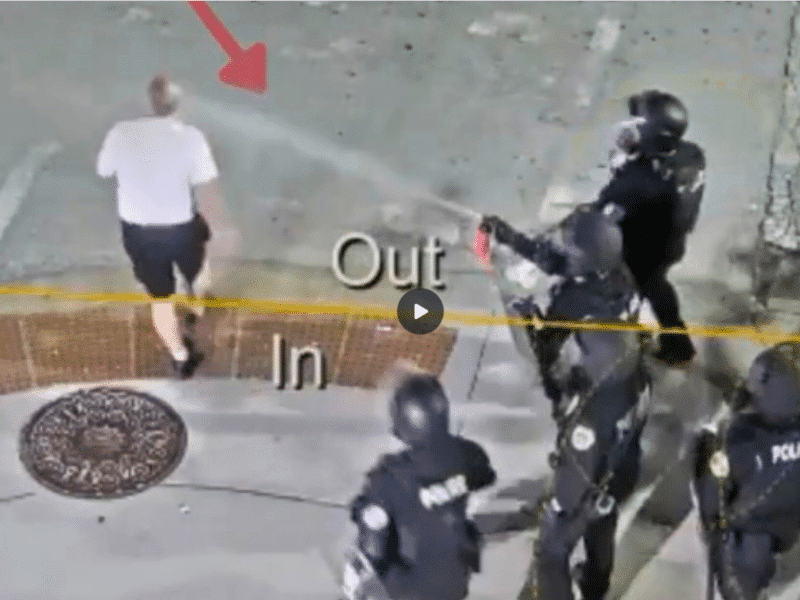
Des Moines police use-of-force reports from 2020 George Floyd protests subject of new Just Voices’ review
Just Voices will release a series of essays centered around the Des Moines Police Department’s use-of-force reports during the 2020 George Floyd protests.
The Rest of the Story: A look at a high profile leader and the lawsuits behind the 2020 George Floyd protests in Des Moines
Volume 2 of “The Peoples History” will be available soon and detail the impact of the 2020 George Floyd protests in Des Moines, Iowa.