
Black superintendents fight school-to-prison pipeline amid ‘prioritization of politics over education’
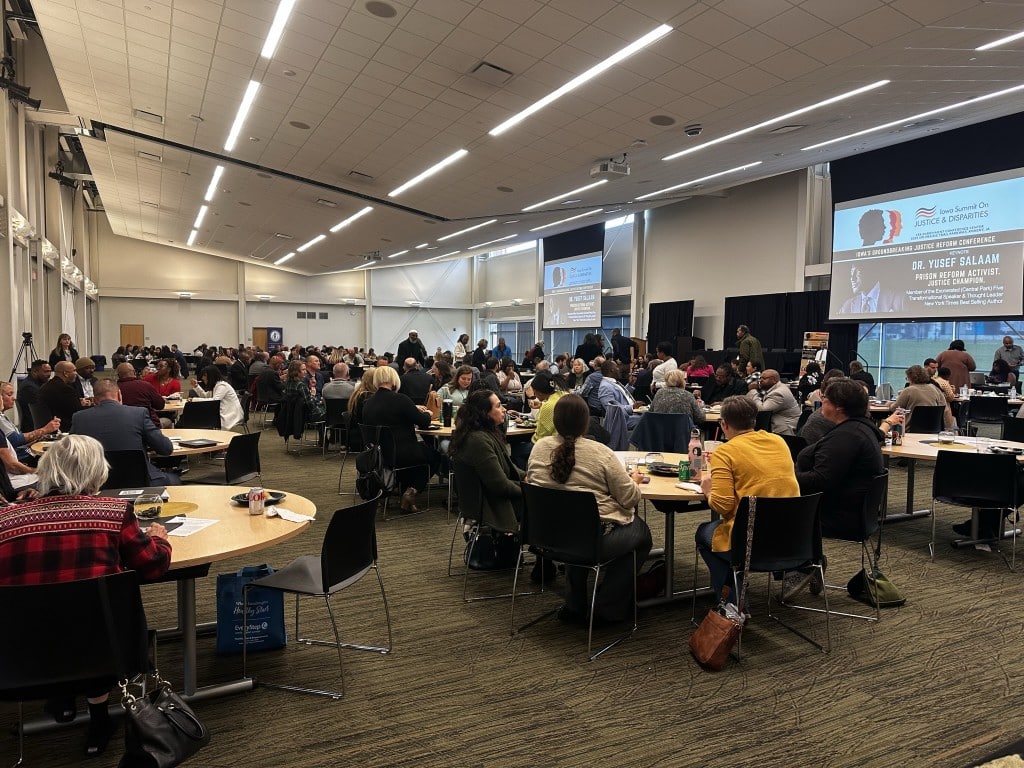
Three of the state’s Black school superintendents discussed the school-to-prison pipeline during a recent criminal justice reform summit.
Public schools need more funding to pay for counselors, social workers and programs, in addition to school leaders and teachers who empathize with their students — and look like them — to disrupt the school-to-prison pipeline, said three Black superintendents during a recent summit on criminal justice reform.
But, a recent law allowing parents to use state education funding to pay for private schools means Iowa school districts must devise ways to do more with less, the school leaders told attendees at the recent Iowa Summit on Justice and Disparities held in Ankeny.
The superintendents included Julious Lawson, of Ames; Erick Pruitt, of Ankeny and Ian Roberts of Des Moines. Victoria Henderson-Weber, a recent Des Moines school board candidate, served as host.
“We cannot handcuff public schools by sending public dollars to private institutions,” Pruitt, superintendent of the Ankeny Community School District, said to applause at the panel, “What School Districts Can Do to Interrupt the School-to-Prison Pipeline.”
Roberts said the Des Moines district is slated to lose 1,300 students because of the state’s voucher program. He said for the first time in history, “We are seeing a dynamic that exists between education and politics where there is the prioritization of politics over education.” Even so, it’s necessary to work collaboratively with state legislators on school funding, he said
The superintendents discussed school discipline policies, funding, mental health and teacher quality, among other topics. They fielded questions, including how districts can measure whether they’re effective at reducing the school-to-prison pipeline, which includes policies and practices, such as suspensions, expulsions and zero-tolerance policies, that place students on a path to involvement with the criminal justice system.
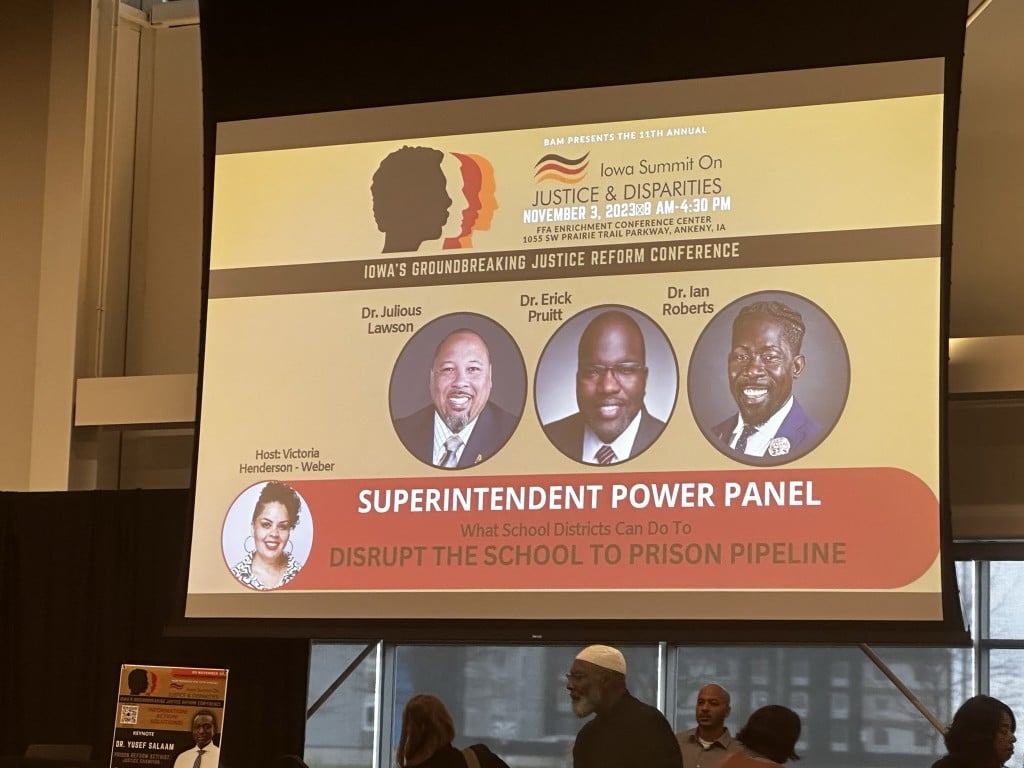


At his first principalship in Chicago, Illinois, where Lawson previously worked, district leadership told him, “You are out of your mind” when he ceased suspensions. Now, in Ames, he’s starting to push for mediation.
“When you can sit and have young people communicate, even adults and young people because sometimes it’s where the conflict is, miracles happen,” he said. “So mediation is one of the things that I’ve really started to push in Ames, and I’m slowly doing away with suspensions and expulsions altogether because there is no research that supports the use of suspensions or expulsions that lead to successful outcomes.”
Pruitt, who said he’s an advocate for restorative practices, agreed, saying: “Suspensions don’t work.”
Roberts said: “We have not expelled a single student in Des Moines public schools in the last five years.”
Instead, students are offered virtual schooling or counseling or other supports, he said, adding that partnerships make it possible.
Making better decisions
The superintendents agreed funding for Pre-K and early literacy programs is key to student success.
“It’s been found in Chicago, Houston and here in Ankeny that if we have more students proficient by the end of third grade, that had a dramatic impact on their trajectory in school and is connected to that school-to-prison pipeline,” Pruitt said.
Roberts, superintendent of Des Moines Public Schools, said recent test scores showed Des Moines’ five high schools “have demonstrated the strongest growth amongst any high school in the metro area.” He said before third grade, students are learning to read, and after third grade, they are reading to learn.
“Seventy percent of those prisoners who are incarcerated in state and federal prisons in the state of Iowa are reading below a fourth-grade level — 70%,” he said. “So that tells us that there is a positive correlation between a failure to get students to learn how to read . . . and what happens in terms of students moving into their adulthood not being able to read and ultimately falling into the school-to-prison pipeline.”
Roberts said school leaders and teachers must lead and teach “from an orientation that is empathetic.” He said high suspension rates in the ninth grade can increase the likelihood that students will drop out of school.
“And so we have to make better decisions looking at restorative justice, restorative practices and out-of-school suspensions and make better decisions around how we’ve treated our students,” he said.
How did we get here?
Roberts said the Columbine school shooting, which happened in 1999 in Colorado, ushered in zero-tolerance policies that disproportionately targeted Black and Brown students and fueled the school-to-prison pipeline. The problem starts in the classroom with suspensions and out-of-school suspensions, he said.
“I think the onus is on us, those of us who serve in pre-K-12 education, certainly superintendents, we have to find a way with intentionality to disrupt it,” Roberts said.
Soaring mental health needs
Districts need more funding to pay for mental health support, social-emotional learning and counselors to help students who have “significant mental health issues,” Roberts said.
Pruitt said school counselors and social workers are over-extended locally and nationally. More community partnerships are needed, he said.
“I think that our resources are our greatest challenge in education around how our schools are funded, and what our priorities are here, particularly in this state,” Pruitt said.
Lawson, the Ames superintendent, said research has found that students who are connected to school are less likely to engage in risky behaviors, have lower levels of mental health challenges and have higher rates of attendance and higher rates of achievement.
Des Moines policy change
The Des Moines district is changing its hiring policy related to applicant’s criminal records. Roberts said someone with a misdemeanor or felony in their background from 1986, that doesn’t include sex offenses or student offenses, for example, could be considered for employment.
“So what happens is now we have individuals that not only served their time, have paid their debt to society, are now doing well in our communities, but we are still saying that they are not eligible to be a part of the educational journey of our students,” Roberts said. ”People are so much better than the worst thing they’ve ever done.”
Teacher quality is key
Lawson, the Ames superintendent, said growing up on the South Side of Chicago, he had many teachers who “didn’t have the capacity to move me.” That’s why he prioritizes teacher quality because “if you don’t have the capacity to do the work, you’re shortchanging children, and so we can’t afford to do that to those young minds.”
“That’s why I believe teacher quality is critical. It’s mission-critical for me, and it’s a huge push in the work that I do from day to day,” he said, to applause.
The summit, founded by Betty Andrews, of the Iowa-Nebraska NAACP, is in its 11th year and was held on Nov. 3.
Author

Related Articles

Five Des Moines students receive Inaugural Teree Caldwell-Johnson Servant Leader Scholarships
The inaugural scholarship recognizes underserved students pursuing higher education while carrying forward Teree Caldwell-Johnson’s commitment to opportunity and service.
Iowa’s new classroom removal law: What Black parents need to know and do now
Iowa legislators passed SF2428, changing how school districts deal with classroom violence and disruptions.
New ACLU report reveals Black Iowa students continue to face disproportionate school arrests, referrals by school resource officers
Report found Black students and students with disabilities face disproportionate arrests and referrals by school resource officers.