
Black Iowans hit hardest in Iowa’s soaring cancer rates
Advocates explain how policy choices and legislative choices affect cancer rates for Black Iowans.
Black Iowa News will publish more on the connection between cancer rates and Iowa’s water quality and the 2026 cancer report in an upcoming edition of the Black Iowa Newspaper.
Black Iowans face some of the state’s most striking cancer disparities, and growing economic instability could widen that gap.
According to the 2025 report issued by the Iowa Cancer Registry, Iowa has the second-highest age-adjusted rate of new cancers diagnosed and is one of only two states with a rising age-adjusted rate of new cancers.
The report found that non-Hispanic Black people and Hispanic Iowans have an earlier average age of diagnosis (age 60 for Black Iowans, age 55 for Hispanic Iowans) and lower survival rates (67% among Black Iowans and 70% among Hispanic Iowans) compared to non-Hispanic white individuals.
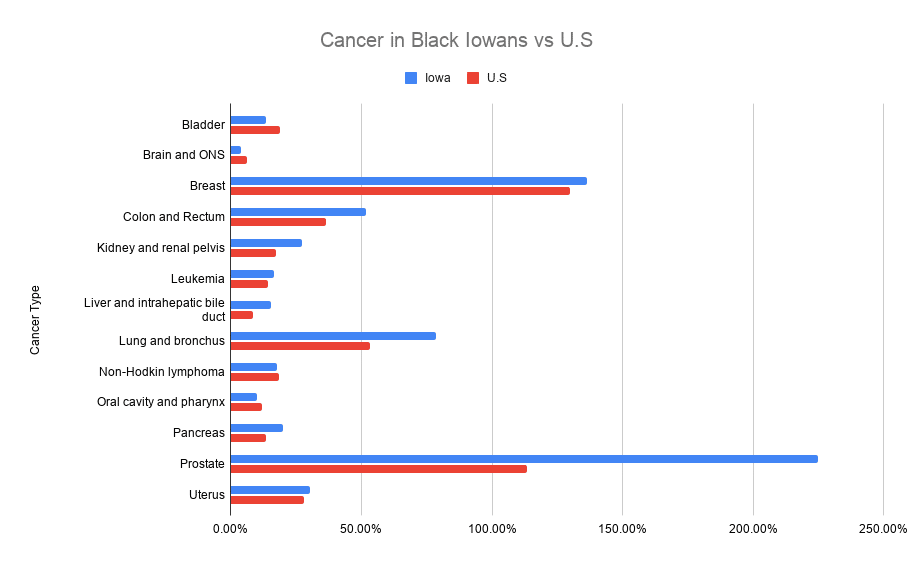
More than 1 in 20 people in Iowa have had a diagnosis of cancer at some point in their lives, the report shows.
The Iowa Cancer Consortium’s Black Hawk County Community Steering Committee makes equity in health care one of its main key points. In a video posted by the consortium, member Lischelle Oliver, also a medical assistant, shared the health disparities she witnessed growing up and how they inspired her to lend a hand.
“Growing up, you can see with health care, where if you have money, you can buy anything,” Oliver said. “You can buy time. But the people who don’t have much need help, and I want to be there to help.”
A 2024 report from the registry explained that prostate cancer is the most common in Black Iowans, especially Black men, who experience higher rates of it compared to their white counterparts. However, these disparities are not limited to men. Black women face higher mortality rates from breast cancer, which was the most common cancer diagnosis in Iowa in 2025, than white women.
According to the American Cancer Society, Black women in the U.S. are about 38% more likely to die from breast cancer than white women, even though their risk of developing the disease is similar or slightly lower. Black women also tend to be diagnosed at later stages and have lower survival rates at most stages of cancer, showing the disparities directly linked to access to early detection and care, according to the report.
While biology plays a role in the probability of cancer diagnoses, access to screening, early detection and timely treatment is largely affected by disparities in diagnosis and survival. Iowa’s water quality and nitrate levels have also sparked concerns about their connection to the soaring cancer rates.
Economic stability, always a factor in the Black community, plays a crucial role in access to health care.
A recent Black Iowa News report detailed how Black Americans face higher unemployment rates, which is double the national average. Job loss often means losing employer-sponsored health insurance, which can make it difficult to access consistent health care for preventive cancer screenings and follow-ups on abnormal results.
Research from the American Cancer Society found that unemployed adults are less likely to be up to date with cancer screenings due to ack of health insurance.
Kelly Sittig, executive director of the Iowa Cancer Consortium, said that policy could drive change.
Policy plays a powerful role in shaping cancer outcomes,” said Sittig. “It influences prevention, early detection, treatment and quality of life.” When structural and financial barriers limit people’s ability to access care, disparities grow, she said.
“When we rely only on individuals to manage risks, we miss the broader systems that shape who gets sick and who survives.”
Lawmakers in Iowa are considering more than a dozen bills to tackle the high cancer rates.
The bills address a wide range of issues, including breast exams, nicotine products, research, radon testing, and vaccinations, among others.
| Cancer Type | Rank in U.S. | Rank for Black Iowans |
|---|---|---|
| Lung cancer | #3 most common | #2 |
| Colorectal cancer | #4 most common | #4 |
| Kidney cancer | #7 | #1 |
| Leukemia | #11 | #1 |
| Oropharyngeal cancer | #10–12 | #1 (Black men) |
| Prostate cancer | #2 | #4 (Black men) |
While biology plays a role in the probability of cancer diagnoses, access to screening, early detection and timely treatment is largely affected by disparities in diagnosis and survival. Iowa’s water quality and nitrate levels have also sparked concerns about their connection to the soaring cancer rates.
Economic stability, always a factor in the Black community, plays a crucial role in access to health care. A recent Black Iowa News report detailed how Black Americans face higher unemployment rates, which is double the national average. Job loss often means losing employer-sponsored health insurance, which can make it difficult to access consistent health care for preventive cancer screenings and follow-ups on abnormal results.
Research from the American Cancer Society found that unemployed adults are less likely to be up to date with cancer screenings, a big reason being a lack of health insurance. Kelly Sittig, executive director of the Iowa Cancer Consortium, said that policy could drive change.
“Policy plays a powerful role in shaping cancer outcomes,” said Sittig. “It influences prevention, early detection, treatment and quality of life.” She went on to say that when structural and financial barriers limit people’s ability to access care, disparities grow. “When we rely only on individuals to manage risks, we miss the broader systems that shape who gets sick and who survives.”
Lawmakers considered more than a dozen bills to tackle the high cancer rates. The bills that advanced through a full committee are:
- HF 318: would address cost-sharing for diagnostic and supplemental breast examinations.
- SF 2421 and HF 2635: would, among other things, eliminate prior authorization requirements for certain cancer services, including cancer‑related screenings and cancer‑related preventive services.
- SF 638 and HF 2011: would develop an Iowa Cancer Research Fund from taxation of certain nicotine products.
- HF 2310: would provide a standing appropriation of $1 per Iowa resident (up to $3 million per year) for pediatric cancer research to the Board of Regents for University of Iowa Health Care.
- HF 2663: would appropriate $2 million to the University of Iowa to help discover the underlying causes of cancer. It would also appropriate $3 million to Iowa HHS to support clinical cancer research and programs to increase access to clinical cancer research trials for Iowans.
- SF 304: would remove a minor’s right to consent to receive the HPV vaccination.
- HF 2171: would eliminate vaccine requirements for elementary and secondary school.
- HF 571: would allow medical practitioners, health care institutions, or health care payors to not participate in or pay for a health care service that violates the medical practitioner’s health care institution’s, or health care payor’s conscience.
- HF 2297: would require that new single-family or two-family residential construction must include passive radon mitigation systems.
- HF 524: would require one-time in-person written parental consent for people under the age of 18 to use a tanning facility.
- HF 2406: would increase the cigarette tax by $1.50 per pack and would add a 50% wholesale tax on e-cigarettes, nicotine pouches, and similar products.
- SF 2444: would modify Iowa’s Smokefree Air Act to create an exemption for cigar bars and establish a regulatory framework allowing them to conduct delivery sales of premium cigars.
- HF 2664: would increase Iowa’s taxes on cigarettes, tobacco products, and vapor products. It would raise the cigarette tax from $1.36 to $2.86 per pack and would also increase the tax on loose tobacco used in vending machines. It would the existing combined 50% wholesale tax rate on other tobacco products to vapor products as well.
Author

Related Articles
The Price of the Style: Toxic chemicals used in synthetic braiding hair raise health concerns for Black Iowans
A study found toxic chemicals and unidentified ones in the hair extensions that Black consumers use to create their popular braided hairstyles.

Bridging the gap between awareness and action: Expanding the impact of Black health and wellness fairs
Fitness expert Coy Jackson shares how exercise and lifestyle changes can help lower blood pressure and improve heart health.

Study reveals stress contributes to Black Americans’ higher risk of mortality
Racism and societal structures worsen stress and inflammation in Black Americans, which could lead to chronic problems, a study found.