
The Importance of James Baldwin
One does not read Baldwin to escape, but to be awakened — just what 16-year-old Shade Burgs would discover.
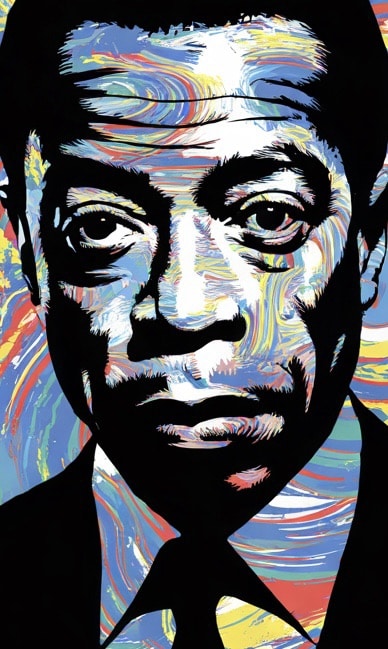
The spring of 1987 was a monumental time in my life. I was dating a girl, had held her hand in public. I’d even kissed her in front of my friends. I shopped at Merle Hay, Valley West, and South Ridge malls all in the same day — by myself. I’d bravely defied my mother by getting my ear pierced without her permission. Because with 16 years of wisdom, I was a man, and a man makes his own choices. That’s when I stumbled upon the existence of James Baldwin through the autobiography of Malcolm X, because in my head, I was on a first name basis with these giants.
Deciding to educate myself further — because that’s what you did before the internet became our collective brain — I braved the labyrinth of the school library, wrestling with the archaic beast known as the card catalog and the mystical Dewey Decimal System like a technologically deprived Indiana Jones.
Upon discovery, I was initially struck, my face contorting to that of a questioning puppy. Baldwin was unapologetically, flamboyantly and fabulously gay? It confounded me — could someone so dramatically different from myself pen words that would resonate with me? In comparison, Langston Hughes was straight-presenting, and at the time, in my 16-year-old mind, I had no clue how possibly gay he was. Spoiler alert: I was wrong. Profoundly, shockingly, embarrassingly wrong about both of these men.
As I turned pages in “Go Tell It On The Mountain,” it wasn’t just the prose that struck me; it was the how Baldwin wrote about cold, harsh, ugly things in the most beautifully articulate way. He didn’t just write sentences, he stabbed you simultaneously through the brain and heart with a pen, and cast you effortlessly — not to a land of make believe, (no no, sweet child, there will be none of that here) but into the depths of gritty truth and harsh reality of his experience and existence. The kind that makes you squirm because it’s too real. Written in words that make you cringe emotionally as you relate to them directly.
One does not read Baldwin to escape, but to be awakened. His writings are a series of gut punches wrapped in a velvet boxing glove, delivered with the grace of a poet, the precision of a surgeon and the strength of Mike Tyson. Through his words, I found an unexpected kinship. Not only the connection between author and reader, but a bridge built of shared human truths told in a language so potent, so visceral it transcended the superficial differences I once thought insurmountable.
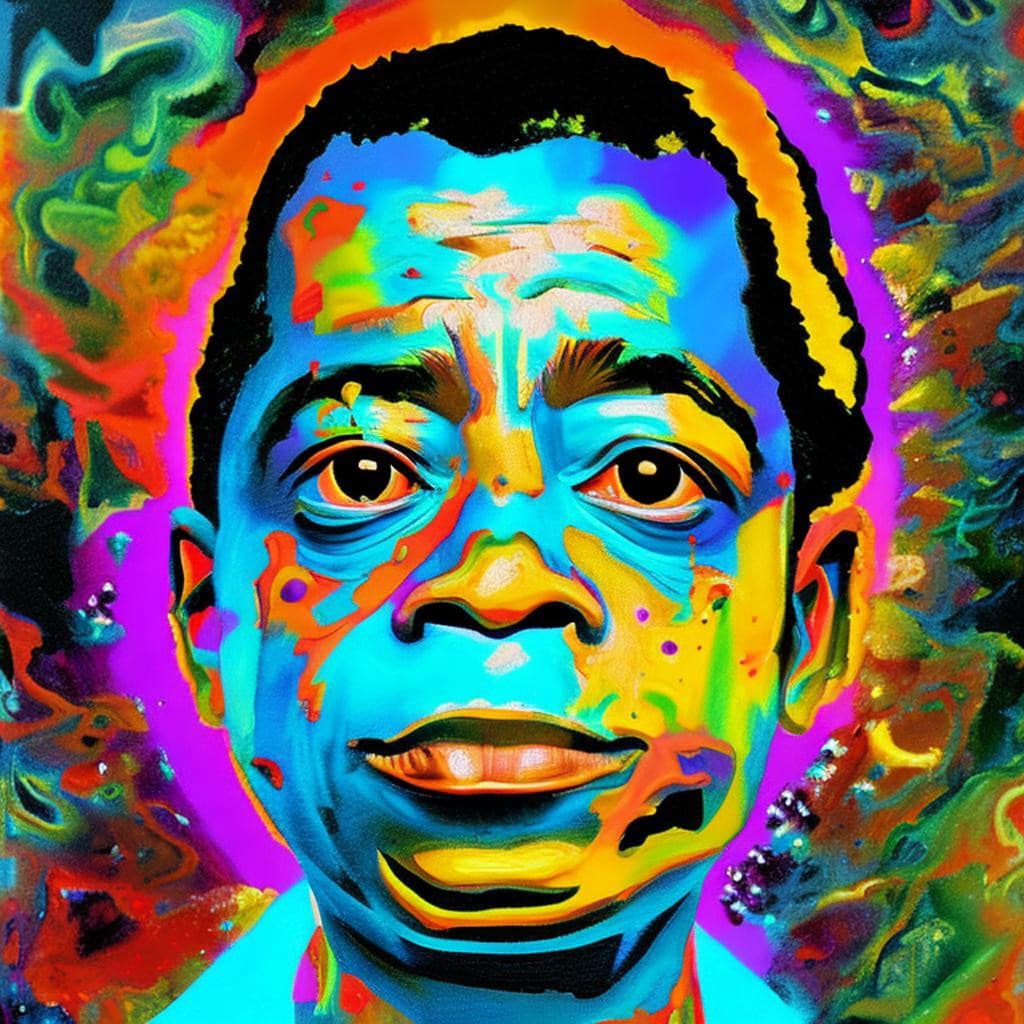
The story of James Arthur Jones is not exactly a classic bedtime fairy tale. Born in 1924 to Emma Jones, he started his journey by the stroke of a matrimonial pen in 1927, voila,(”wa-laaah” for those who don’t read French). Rev. David Baldwin steps in, James gets a shiny new last name, and, ta-daaah, becomes James Arthur Baldwin.
He was the distinguished first of nine children and a veritable shepherd leading the flock. From the get-go, James was branded as different. In those days, being tagged as different was not quite a badge of honor. James always stood out, smaller than the other kids, as well as feminine in nature, he was often called ugly or frog eyes by his stepfather and “sissy” by others. His mother, bless her soul, cradled these differences, whispering praise and grandeur into young James’ ear.
On the flip side, David Sr., however, was, to put it mildly, less of a fan. Oftentimes, berating the mother with the same toxicity and callousness he spewed at his stepson.

As with many Black folks at the time, their entire lives revolved around the church. Books other than the Bible were not allowed in the elder Baldwin’s house, but James was different, often finding himself in trouble with his father because his mind was not limited to just the Bible.
While in grade school, he met Orillia Miller, a teacher who recognized his uniqueness among other students. They developed a great friendship, with Orillia (who James called Bill) recognizing things in James that were far advanced for someone of his age, as well as traits and characteristics that weren’t foreign to herself. Orillia encouraged James to embrace his curiosity. Orillia visited his parents seeking permission to take him to plays and movies as well as different libraries and museums. It was not a very well-received idea by his father, as she was a white woman wanting to expose his Black child to the world, David relented at the behest of Emma, who pointed out how James had an opportunity to be “better than them white boys” he personally despised. It was Orillia who took James to his first movie starring Bette Davis. He was struck by how Bette’s eyes were like his eyes, like his mother’s eyes, yet she was seen as beautiful. That moment lit the fire in him that would be the ignition of his inspired life.
In an unexpected plot twist, our villain…umm…I mean stepfather, decided that at 14, the ministry was James’ calling. Because nothing says fatherly love like forced career paths and toxic masculinity. But here’s the thing, James excelled. He didn’t just walk in the ministry, he stomped like Sasquatch with flair and fire that was completely undeniable, leaving dear old dad’s achievements in the dust. The church overflowed with gleeful parishioners, and people came from all over New York to bask in the glow of this radiant child. To me, that’s a testament to James’ charm and eloquence. I believe this is where he fell madly in love with the allure of the written word, baptizing his thoughts in ink and christening pages with them as he prepared his sermons. He discovered not only the divine power God but also the divine power God gave the written word.
He applied at DeWitt Clinton High School in the Bronx, which was a significant trip by bus across the city. He looked forward to separating himself from the kids in his neighborhood school, it was his first escape. While there, he was a writer and student editor of “The Magpie” student newspaper. After graduation, he did not attend college but worked in sweatshops around the city and even laid some of the very same tracks the subway system operates on to this day. James became literally a part of the formation of what we know as New York City. While working after high school, he still frequented movies and Broadway shows, becoming friends with artists, actors, poets, photographers, playwrights and musicians. He also continued writing. He was rejected by several Black-owned newspapers because he didn’t have a college education, but that did not stop him from writing. If anything, it forged his pen into an invincible weapon against societal norms of acceptance.
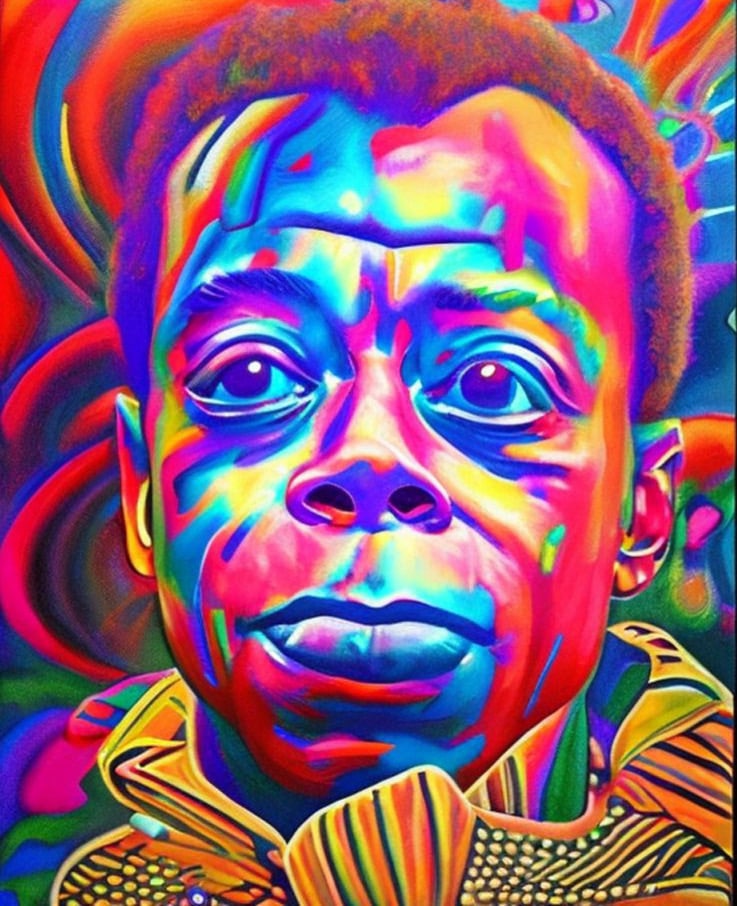
In 1946, he awoke one morning to news that his best friend Eugene Worth had jumped to his death from the George Washington Bridge. That, along with the crushing racism and homophobia of American culture at the time, had pushed James down as far as he could go. He fell into a deep depression, embracing a lifelong love affair with alcohol (bourbon in the winter and gin/vodka in the summer, as any gentleman of class and culture would know). Two years later, he and a fellow artist/mentor, Bernard Hassell, moved to Paris, France, to escape. With Baldwin noting, “I had to leave America; it was my country, but not my home. I was either going to go crazy, kill someone, or end up dead, and I didn’t like any of those options.”
James, in his prophetic wisdom, decided Paris would be his paradise. With his entire fortune of $40 and a linguistic prowess that didn’t extend beyond merci and baguette, he set off. He likened his first year to a silent film, in which his most significant role was that of a mime, mastering the art of expressive eyebrow-raising and emphatic shrugging. France, in its infinite mercy, taught him the invaluable skill of deciphering human emotions without the cumbersome need for words, a sort of emotional telepathy, which for a writer had to be a completely new and significantly different experience.
Here was a man who did not relish in the novelty of not being reduced to his skin color at home, now placed where his skin color and American identity suddenly became a chic exoticism, rather than a mark of unwanted otherness. No longer was he ‘boy,’ a term so liberally sprinkled into conversations back home; in France, he was Monsieur American, an upgrade by any measure. They say survival is for the fittest, but in James’ case, it was for the most well-connected. Here’s to the couches that bore his weight and to Marlon Brando and company, whose generosity meant James could pursue writing without the menial inconvenience of a day job. Paris didn’t just teach him the art of living; it gave him the art of thriving on sheer will, wit and the bizarre generosity of the artistically rich and famous.

Reading Baldwin made me realize my life wasn’t just about fighting for acceptance in grayscale, it was more nuanced. Not just being the what of who I am, but the deeper meaning of being the who of what I am. To be recognized not just as a “Black man” but for the rich, finely hand woven tapestry that made me embrace that soulful essence beneath my skin. In an era blissfully ignorant of toxic masculinity, where boys teetering on the edge of puberty were indoctrinated with the idea that feelings were as exclusive to girls, and where the yardstick of masculinity was how well you could tackle someone on a muddy field, I was on a quest to discover myself. Baldwin showed me that I could rage with the fire of a thousand suns internally, yet maintain the calm stillness of a stone in the cool autumn breeze. But the thing I learned most from James was how to be comfortable with my flaws and imperfections. How to embrace the things that people did not like about me just as much as the characteristics they loved, and be as comfortable in them as a pair of warm slippers in the winter.
I played football in high school, it was fun but a bit challenging for the skinny kid who didn’t really have the best abilities with pigskin, pads and cleats, I was definitely an artist. Sneaking off after my parents went to work on the overnight shift. I’d tag walls and create what I believed to be masterpieces with spray paint I had liberated from Target, Dahl’s, Miller Hardware and just about anyplace else I could. There were times when I would literally stay out all night tagging or creating with friends, listening to the latest Chuck E. Fresh mixtape. I would catch the bus to school from wherever I ended up, and come from home after school long enough for my parents to see me go to bed. Then, when they would go back to work and I’d be out again for my nightly adventure, like some strange teenage artistic super villain. The nights were mine, and the city my canvas. On one adventure, I remember having to run from three different squad cars after we did a huge piece under a local bridge by Good Park in Des Moines. I turned down every alley, hopped every fence, climbed a tree to get to a garage roof, then jumped down and took off running for my life. I knew if I got caught, my mother would invent time travel by successfully knocking my behind into next week.

Ah yes, in my youthful naivety, I decided that the life of small-town Iowa was not expansive enough for me. Clearly, the best way to avoid the existential dread of row upon row of cornfields was to enlist in the Army for a casual six-year stint. In exchange for a small portion of my sanity, soul and the earliest years of my adulthood, I received an action-packed, all expense paid heavily armed trip to Europe. The only minor hurdle was surviving Basic and Army Individual Training without succumbing to the shock of realizing that Army life was perhaps a smidge more intense than I might have been prepared for. Remarkably, this forged my unbridled childish irresponsibility into a form of unstoppable refined adult irresponsibility.
I transformed into the quintessential example of military efficiency: a specimen capable of drinking like Hemingway till 4 a.m., then miraculously making it back to post to run 5 miles in morning PT by 6 a.m. I have the fondest memories of running through the German countryside, more blurry and swirling than a Van Gogh painting. Ok, so it was more like a high-speed staggering stumble we called “the airborne shuffle,” but it looked like I was running, so it counts.
With my military ID in hand, and a 3 day pass in my pocket, I was ready to indulge in every aspect of exploring Europe. I learned how to drive a manual transmission with my buddy “Tripplette” in a rented Porsche 928. I hopped on trains going to places I couldn’t begin to pronounce correctly, but met people who were kind and generous enough to show the funny American kids, with military hair cuts and a pocket full of your parents hard earned tax dollars, where to go and what to do. I traversed Italy, drank Sherry in Spain, had “coffee” in Amsterdam, met punk kids in England, and danced the night away in France with the finesse of a cultural connoisseur, if such a connoisseur wore combat boots, could disable an opponent in three moves and could fall asleep anywhere.
When I arrived in Paris, the city of love, light, and presumably countless lost American soldiers on leave, I finally grasped Baldwin’s fixation. Perhaps it was the charm of the city, or maybe the intoxicating company of the local women and the inexplicable decision to greet sunrise with more alcohol and breakfast on our hotel terrace. As we talked with the French ladies over breakfast, and glasses of Beaujolais Nouveau, I realized that moment encapsulated a profound epiphany I think Baldwin also had in this very same city.
Life isn’t about grand achievements or monumental accomplishments, it’s about the fleeting moments of shared intimacy, where you find yourself tipsy at dawn, in mixed company flirting with a beautiful woman, whose name you’ll probably forget: It was Maichelle, (pronounced like May-shella) wondering if you’ll remember the pale peach-pink color of the sky or the taste of French pastries, warm and freshly baked, while wading into the depths of youthful exuberance and purposeful excess against the backdrop of a city that’s seen millions like you, trying to write their own stories into its streets.
In that instant, living felt infinite, tomorrow didn’t exist, and there were no hands on the clock. That moment kicked a hole in the sky for me. I felt the universe give me a subtle reminder that maybe, just maybe, this was what it meant to truly embrace life, regardless of who or what you are.

Author

Related Articles

Iowa ‘3-strikes’ bill could disproportionately impact Black Iowans
Lawmakers debated costs, prison space and racial disparities before passing a bill requiring controversial 20-year sentences for repeat offenders.

Complexions Contemporary Ballet to perform at the Des Moines Civic Center on March 25
Complexions, a diverse contemporary dance company based in New York, will be performing at 7 p.m. on March 25 at the Des Moines Civic Center.

Iowa House District 66 candidate Matt English wants to ‘make your voices heard, flip this seat and make the government of Iowa work for Iowans’
Black Iowa News Q&A: Get to know Matt English, a candidate for Iowa House District 66 in Anamosa, Iowa.