
Polk County to launch its first warrant resolution clinic
The CJCC joined forces with various organizations to help Polk County residents resolve their non-violent warrants.
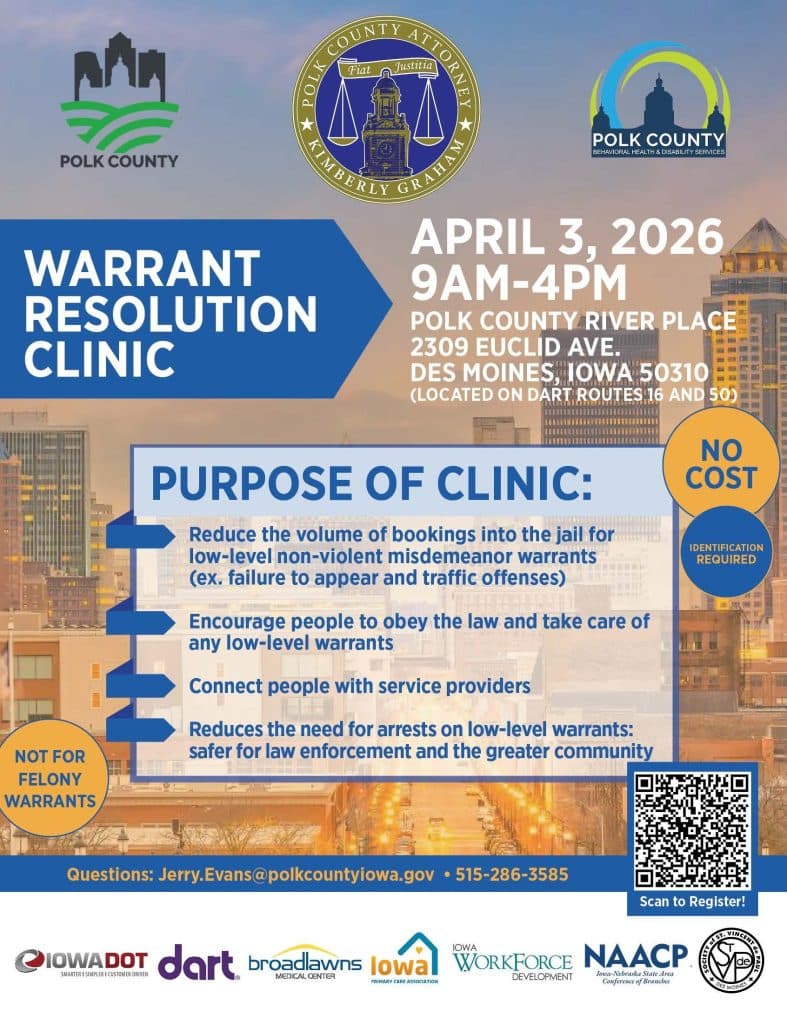
Polk County residents will be able to solve their non-violent warrants through Polk County’s first warrant resolution clinic, which will be open from 9 a.m-4 p.m. on April 3 at Polk County River Place, 2309 Euclid Ave. in Des Moines.
After identifying more than 8,000 non-violent, non-felony warrants in Polk County, Jerry Evans, coordinator of the Polk County Criminal Justice Coordinating Council, joined forces with community leaders like county attorney Kimberly Graham to bring a warrant resolution clinic for those residing in Polk County who have not committed serious crimes or felonies.
Evans explains that one of the main reasons for this decision is that due to the lack of knowledge about low-level warrants, those who have them do not know they can be administratively resolved and fear getting arrested. Through this clinic, where there will be attorneys and judges present, people would be able to calmly reach a resolution that would suit their needs best.
“At the end of the day, this is really about trying to serve our community and get individuals back into lawful status so they don’t have a warrant over their head,” Evans said.
Various local agencies, such as Polk County Behavioral Health and Disability Services and Iowa Workforce Development will help residents arriving at the clinic in any way they can. Other partners are Broadlawns Medical Center, DART, NAACP, the Polk County Sheriff’s Office, and St. Vincent DePaul.
“We have the Iowa Department of Transportation, for example, to help with any driver’s license issues,” Evans said. “We will also have behavioral health there to help people if they need referrals for anything related to behavioral health so they can assist with that.”
The clinic will also offer people the chance to sign up for affordable payment plans to pay off fines and fees and get back their driver’s licenses. County attorney Kimberly Graham says that by reducing arrests for low-level non-felony warrants, officials hope to reduce the volume of arrests for minor crimes like misdemeanors, traffic offenses and failure-to-appear warrants.
“We’re hoping that this clinic would prevent people who, for example, are driving and get pulled over from getting arrested and put in jail,” Graham said. “That’s disruptive to their families, their children, if they have children, if they’re caring for elderly parents, it’s disruptive to that. It could be disruptive to their job. They might lose their job if they get stuck in jail for a couple days.”
To check if your type of warrant is eligible for the clinic, scan the QR code on the flyer below.
Author

Related Articles

Grab a copy of the March edition of the Black Iowa Newspaper
March is almost over, but there’s still time to grab a copy of the March edition of the Black Iowa Newspaper!
Iowa ‘3-strikes’ bill could disproportionately impact Black Iowans
Lawmakers debated costs, prison space and racial disparities before passing a bill requiring controversial 20-year sentences for repeat offenders.

Get to know Black Iowa News reporter: Gretchen Lembcke Peña
Meet Gretchen Lembcke Peña, an accomplished writer with Black Iowa News. Contact her with story ideas and tips.