
OPINION: Valentine’s Day gunfire and the Midwest crossroads
Be heard. Share your opinion with Black Iowa News. Email your unpublished piece to dana@blackiowanews.com.
On Valentine’s Day — a day dedicated to love — three people were shot in Des Moines. Thankfully, no one was killed. But symbolism matters. When gunfire interrupts a day meant for unity, we are called not only to respond emotionally, but to reflect structurally.
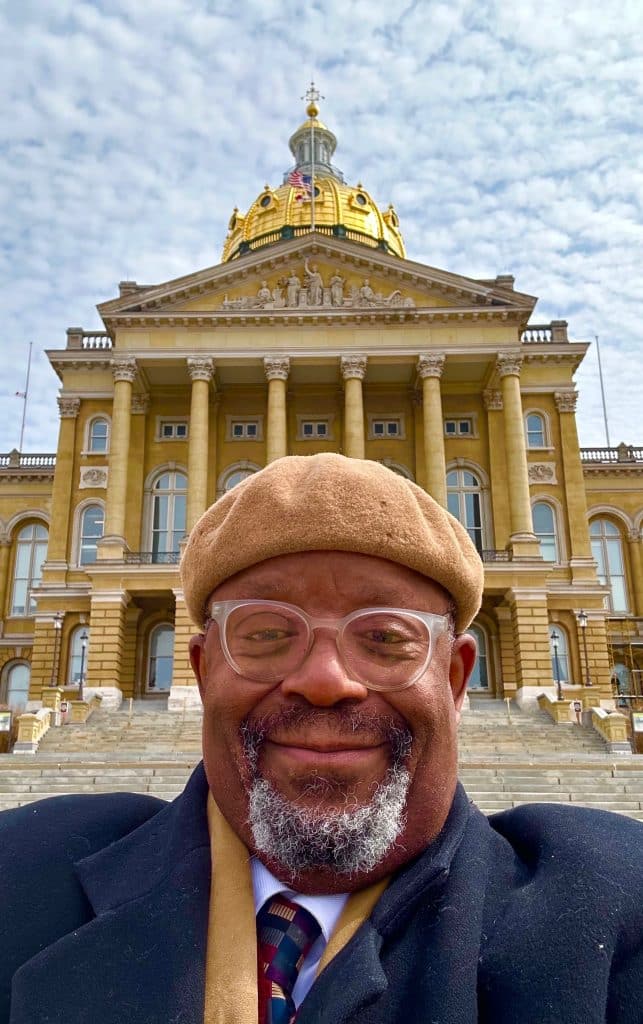
For some, this was another crime headline. For me, it was another signal in a much larger transformation unfolding across the Midwest.
For decades, I have said something that many prefer not to confront: a significant number of the states and cities that rank among the worst places in America for Black residents are located in the Midwest. Annual analyses measuring income gaps, homeownership disparities, incarceration rates and education outcomes frequently place Midwestern states and cities near the bottom for Black quality-of-life indicators.
Milwaukee. Minneapolis. Des Moines. Waterloo. These cities often appear in disparity rankings. The issue is not partisan ideology. It is structural inequity layered over time.
Yet at the same time, demographic research shows that interior regions of the country — including parts of the Midwest — are projected to experience stabilization and relative growth compared to aging coastal regions. States like Iowa are among the oldest in the nation by median age. Without immigration and minority population growth, many Midwestern states would face stagnation or decline.
Here is the paradox: The Midwest increasingly depends on minority growth for economic vitality — yet remains structurally unprepared to deliver equitable outcomes.
By 2050, the United States will be significantly more diverse. The aging white population in many Midwestern states will require workforce replacement, healthcare expansion and economic revitalization. If systems are not modernized now, demographic change will outpace institutional readiness.
We cannot ignore the warning signs.
When shootings occur, we isolate them as criminal events. But violence is often a symptom of layered pressures including economic displacement, concentrated poverty, aging housing stock, environmental exposure, educational inequities and untreated trauma.
I have attended multiple town hall meetings in Des Moines regarding water quality, nitrates and cancer concerns. What I consistently observe is this: the rooms are filled primarily with senior citizens — many retired, many concerned, many engaged. I see very few minorities in those meetings. This is not criticism. It is a structural observation.
Many minority families are working during meeting hours. Environmental risk is often not prioritized because immediate economic survival comes first. Civic engagement around environmental health has not been culturally integrated into many communities of color in the Midwest.
Flint, Michigan, remains a national warning. Lead exposure there was not sudden — it was cumulative. The Centers for Disease Control and Prevention has long documented the neurological impacts of lead exposure on children. Research from institutions including Johns Hopkins University has explored associations between childhood lead exposure and long-term developmental challenges.
After the death of Freddie Gray in Baltimore, public reporting noted that he had experienced lead exposure in childhood — a reminder that environmental hazards and public safety cannot always be separated cleanly. This does not mean environmental exposure causes crime. It means structural conditions shape developmental outcomes.
Midwestern cities contain significant inventories of pre-1978 housing stock, where lead-based paint remains a known hazard.¹ Iowa also continues to face nitrate concerns in drinking water due to agricultural runoff.¹
At the same time, Iowa has recently ranked among the highest states in the nation for overall cancer incidence and has in recent reporting ranked second nationally in new cancer cases.
The American Cancer Society reports that Black Americans experience higher mortality rates for many major cancers compared to white Americans. If a state already faces one of the highest cancer incidence rates in the country, and documented racial disparities exist in cancer outcomes, then environmental equity and health care access become urgent public health priorities.
When environmental concerns arise — whether related to nitrates, aging pipes, or contamination alerts — families with greater financial flexibility can purchase home filtration systems or bottled water as temporary safeguards. Lower-income households may not have those options readily available. Public health research consistently shows that economic constraints influence exposure risk and long-term health outcomes. When mitigation depends on personal financial capacity, environmental equity becomes inseparable from economic equity.
The W.K. Kellogg Foundation has documented that eliminating racial economic disparities in Michigan alone could generate an estimated $92 billion in additional economic growth. Equity is not charity. It is economic strategy.
The Midwest stands at a crossroads.
For nearly 30 years, through Urban Dreams, I worked at the operational level of youth violence and community intervention. Today, through the Wayne Ford Equity Impact Institute, the next step must be institutional.
The Institute is developing a research-based clearinghouse and informational hub designed to integrate environmental, health, demographic and equity data into one accessible reference point for communities, policymakers, researchers and institutions.
Black History Month is not only about honoring the past. It is about protecting the future.
Love requires protection.
Cities do too.
Related Articles

Shorting Black women is costing America billions: Why fully leveraging educated women is critical to America’s economic stability
Writer Debra Carr ponders the economic impact of devaluing Black women at work.

Black Women Can’t Catch a Break
Opinion: Watching high-profile Black politicians get dragged online can trigger trauma in Black women, says writer Debra Carr.
‘Where is the leadership?’ Black Waterloo church pastor discusses community needs
Share your thoughts with Black Iowans across the state. Email your letter to the editor or short piece to dana@blackiowanews.com.