
What do Black Iowans want in the state’s next governor?
With the 2026 gubernatorial election approaching, Black Iowans share their priorities on agriculture, education, and inclusion.
In 2026, Iowans will have the chance to vote for a new governor. While 75% of the state’s governors have been members of the Republican Party, including Gov. Kim Reynolds who isn’t seeking reelection, the next election offers the chance for change. But what do Black Iowans want?
Vincent Lintz, executive director of One Economy Financial Development Corp. is a native of Des Moines. He believes that the way people cast their vote depends on their environment and the circumstances they grew up in.
“[Farmers] are looking at taxes, agriculture and so forth,” Lintz said. “That being said, I think [the next governor] needs to be a bit more all-inclusive. Out in rural America, you don’t have a lot of diversity like here in the metropolitan areas.”
Lintz’s view of inclusivity rings true. Iowa’s Black population grew dramatically by 48%, according to the 2020 census, which is eight times as fast as the Black population across the country. The increase is evident in metropolitan areas like Des Moines (19.0%), Davenport (12.0%) and Waterloo (18.0%). In rural areas, however, the percentage is lower, with 1.5% of the Black population residing outside urban areas, according to the census.
This is reflected in the education system, where there are higher percentages of diversity in schools located in urban areas compared to rural areas. Educators like Abena Imhotep, of Des Moines, is advocating against book bans that erase representation.
“School libraries have had to pull books off the shelves because of the curriculum that is taught,” Imhotep said. “They can’t be racial or ‘divisive’. There is also a law that says that no public universities can have DEI departments. I would like to see, in a perfect world, that our next governor is the reversal of all of that.”
Iowa’s immigrant history also highlights the importance of maintaining these departments and educational freedom, according to Refugee and Immigrant Voices in Action. Immigration is a large part of the state’s culture, economy and community structures, furthering their agricultural development, road construction, among other aspects. From as early as the 1830s, immigrants have called Iowa home. Joy Briscoe, executive director of One Cedar Valley, which is an organization that helps businesses overcome barriers in Cedar Valley, emphasized the importance of immigrants and listening to their needs when it comes to the future gubernatorial election.
“I hope the next governor understands the value of diversity and the value of making sure that you listen to all your constituents,” Briscoe said. “Specifically talking about our newcomer communities, our immigrant families. We’re manufacturing communities.”
Another concern amongst Iowans is the quality of the water they consume on a daily basis.
A recent Associated Press report revealed high nitrate levels in Des Moines-area rivers, where a lot of local drinking water comes from. The report explains the effects of these contaminants, such as birth defects and blue-baby syndrome. Kory May, host of the Same Difference podcast, expressed his concern about this ongoing issue.
“We are not doing enough to regulate and make sure the water is clean here,” said May. “We prolong and poison ourselves when we do not have clean, potable water. And that should start from the state level and enforce whatever laws are necessary to give us all statewide, clean potable water.”
Tackling these issues will begin with a winning candidate.

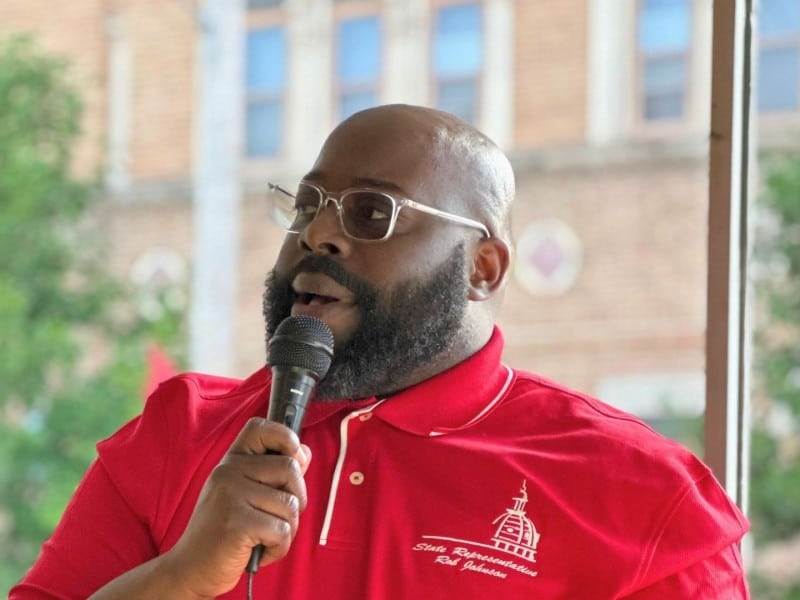
State Rep. Rob Johnson, D-34, shares that Iowa needs a governor who can represent all Iowans and address all of their struggles.
“If anything has gone wrong, if there is anything you’re not happy with about this state, it’s been the same people in charge for 10 years telling you that they are voting in your best interest. When clearly it has not worked out for you,” he said. “Because you’re still struggling to pay your bills. You’re still struggling to make sure that your children are educated freely and openly, with opportunities granted.”
According to the Office of the United States Trade Representative, over 87% of Iowa is dedicated to farmland, making it the second-largest agricultural exporting state in the country. One in five Iowans works in this sector, and many believe that supporting the state’s agriculture should be the top priority in the upcoming election, according to a study conducted by the Coalition to Support Iowa Farmers.
Former State Rep. Wayne Ford says that the next governor must have a different view for the future of the state compared to past leadership.
“We have gone so far right,” he said. “I hope the next governor will have a plan in hand where he or she will bring us back to the middle and beyond the middle.”
The election will be held on Nov. 3, 2026.
This story appeared in the July edition of the Black Iowa Newspaper.
Author

Related Articles

The Iowa America Thought It Knew: Race, Democracy and a Record Worth Remembering
Iowa has a rich history of Black Iowans making an impact on politics locally and nationally, says a former Iowa legislator
Unopposed Doesn’t Mean Unimportant: Rob Johnson Urges Community to Vote
State Rep. Rob Johnson (D-Des Moines) is running unopposed but wants all Iowa voters to turn out for the Nov. 3 general election.
2028 Independent Presidential Candidate Diane Sare Has a Message for Black Voters: Look Beyond Democrats and Republicans
Diane Sare, an independent presidential candidate, decries the “billionaire perverts running things.” Says the U.S. needs a mission, as she laid out her plan during a campaign visit to Iowa.